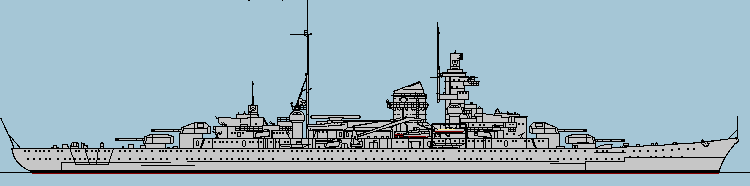
Commissioned.
205,9 mOverall length
18200 tMaximum displacement
32,5 knMaximum speed
~1600Complement
Design and service
The story of Blücher
The Admiral Hipper class emerged from Germany's return to heavy-cruiser construction in the 1930s. Although conceived within the 10,000-ton, 20.3 cm-gun limits associated with the Washington treaty system, the completed ships were substantially larger than the nominal limit.
Five ships were laid down between 1935 and 1937. Admiral Hipper and Blücher formed the first group, while Prinz Eugen, Seydlitz and Lützow incorporated an improved design. Seydlitz and Lützow were initially considered as 15 cm-gun light cruisers, but both were reordered with 20.3 cm guns. The class was intended for commerce warfare, combining heavy armament with sufficient speed to avoid stronger opponents.
In practice, the ships' high-pressure steam machinery consumed too much fuel for sustained Atlantic operations and proved difficult to maintain. Only Admiral Hipper, Blücher and Prinz Eugen were completed as heavy cruisers; construction of Seydlitz and Lützow remained unfinished.
Blücher was commissioned in September 1939 but entered Operation Weserübung before completing a full program of trials and training. As flagship of the force bound for Oslo, she carried troops and government personnel into the Oslofjord on 9 April 1940. Coastal guns and torpedoes at the Drøbak Narrows set the cruiser ablaze and caused her to capsize and sink only hours into her first combat operation. Her loss delayed the German occupation of Oslo and allowed the Norwegian government and royal family to escape the capital.
Operational history
Service timeline
Training in the Baltic Sea.
Operation "Weserübung": Loads army troops in Swinemünde. Together with Lützow, Emden, the torpedo boats Albatros, Möwe and Kondor and the 1st R-Flottilla, the Blücher forms Squadron 5 heading for Oslo.
As the squadron reaches the Oslo Fjord, the ships want to proceed to Oslo without any delay. At 5:20 am the lead ship Blücher enters the narrowest part of the Fjord, the Dröbak Narrows as the fortress of Oskarborg opens fire with its 28cm (11") guns. The ship is heavily damaged at its superstructure and fire spreads. After two hits by Norwegian torpedo batteries the ship sinks at 7:23 am. Even today, the wreck is still loosing oil and endangers the environment of the Oslo Fjord.
At a glance
Technical profile
Dimensions, armament, protection and performance.
Dimensions
- Size (Max)
- 18200 t
- Length (Total)
- 205,9 m
- Beam
- 21,3 m
- Draft
- 7,7 m
- Crew
- ~1600
Armament
- 20,3cm SK (8")
- 8
- 10,5 cm L/65 C/33
- 12
- 4 cm Flak
- 6
- 3,7 cm L/83
- 8
- 2 cm MG L/64
- 32
- 53,3 cm Torpedoes
- 12
Aircraft
- Arado Ar 196
- 3
Protection
- Deck
- 12-50 mm
- Belt
- 70-80 mm
- Command Tower
- 50 - 150 mm
- Turrets
- 70 - 105 mm
Machinery
- Shafts
- 3
- Turbines
- 3
- Type
- Blohm & Voß
Performance
- Total Performance
- 132000 shp
- Speed
- 32,5 kn
- Range
- 8000 miles at 20 kn
The archive
Models
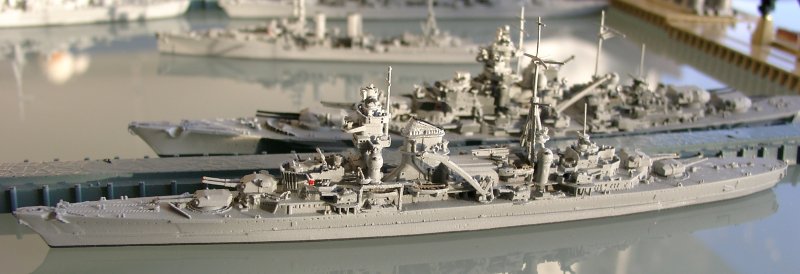
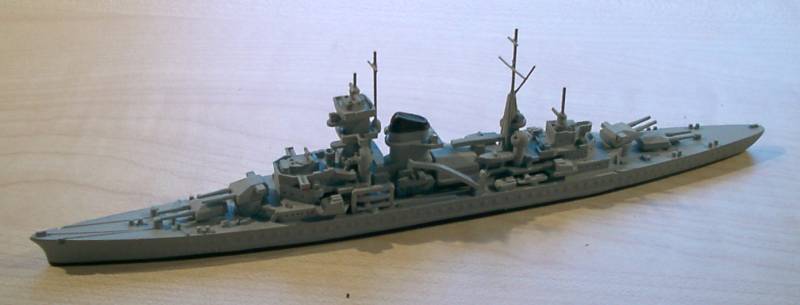
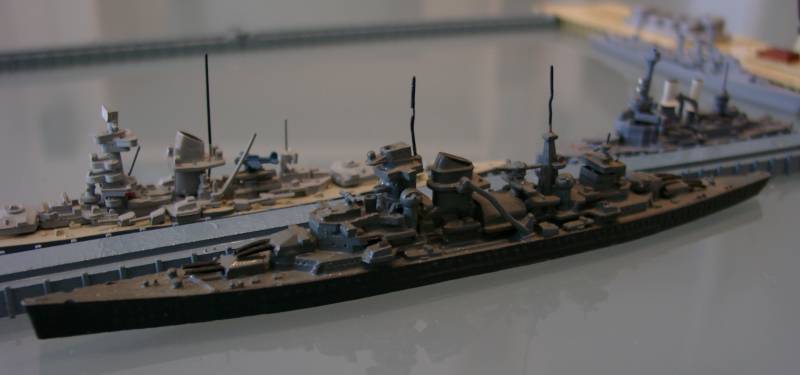
Ship models in 1/1250 scale.
Construction record
Blücher
- Laid down
- Deutsche Werke Kiel, 15.08.1935 (Slipway 2)
- Launched
- 08.06.1937
- Commissioned
- 20.09.1939
- Fate
- sunk 09.04.1940 (Oslo Fjord)
- Cost
- 87,8 Mio Reichsmark