
Commissioned.
186,0 mOverall length
16023 tMaximum displacement
28,5 knMaximum speed
1001-1150Complement
Design and service
The story of Admiral Graf Spee
The Treaty of Versailles sharply restricted German naval construction after World War I. Germany could retain six old pre-dreadnought battleships, six light cruisers, twelve destroyers and twelve torpedo boats. Article 190 permitted replacement of the battleships twenty years after commissioning, but limited each new armored ship to 10,000 tons.
The first replacement, Panzerschiff A, was ordered in 1928 and later entered service as Deutschland. Designers considered both a heavily armored coastal-defense ship and a faster cruiser with greater range but lighter protection. The latter concept was selected because it could threaten French merchant shipping while avoiding more powerful warships.
The design principle was to outrun any more heavily armed opponent and outgun any faster one. This concept was credible against the cruisers and older battleships then in service, although it became less effective after the appearance of fast battleships.
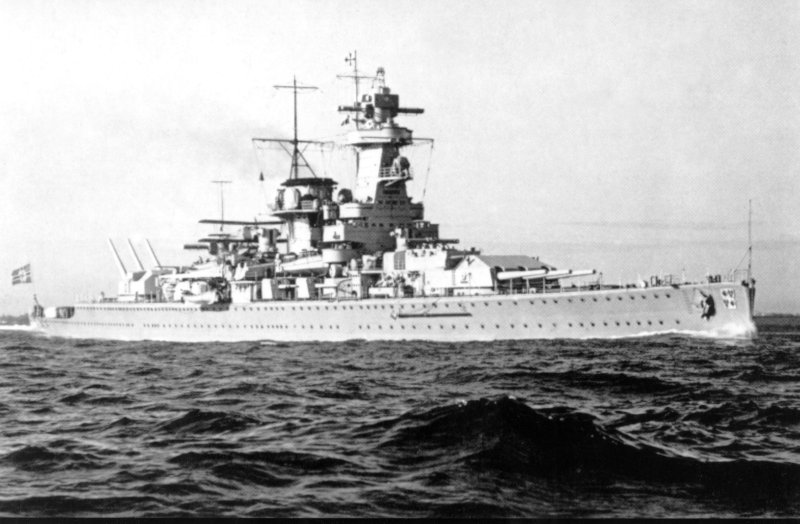
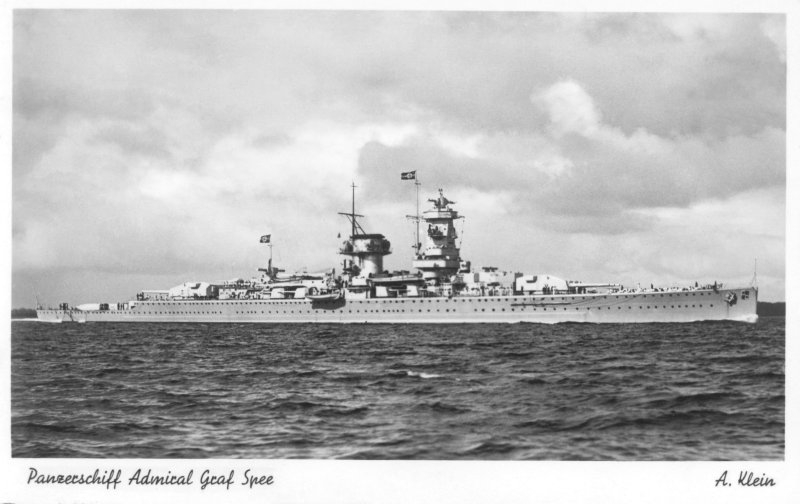
The Panzerschiffe introduced extensive welding and diesel propulsion to ships of this size. Welding reduced structural weight, while diesel engines provided the long range required for commerce warfare. Their declared displacement was 10,000 tons, but full-load displacement was about fifty percent greater. Deutschland, Admiral Scheer and Admiral Graf Spee shared the same basic design but differed visibly, particularly in their bridge structures.
All ships were used in the international sea patrols off the Spanish coast during the Spanish Civil War and had different fates in World War II. The Admiral Graf Spee was lost early in the war when it was scuttled after the famous battle of the River Plate.
Admiral Graf Spee entered service in January 1936 and spent much of her prewar career on Atlantic training cruises, non-intervention patrols off Spain and ceremonial duties, including the 1937 fleet review at Spithead. Sent into the South Atlantic shortly before the outbreak of World War II, she began commerce-raiding operations in September 1939 and sank nine British merchant ships totaling 50,089 tons in the South Atlantic and Indian Ocean. On 13 December 1939 she encountered the heavy cruiser Exeter and the light cruisers Ajax and Achilles in the Battle of the River Plate. After damaging all three opponents but suffering casualties and damage herself, Admiral Graf Spee entered Montevideo for repairs. Forced to leave the neutral port within 72 hours, she was scuttled by her crew in the Río de la Plata estuary on 17 December 1939.
Operational history
Service timeline
Training and trials.
The Admiral Graf Spee enters active fleet service.
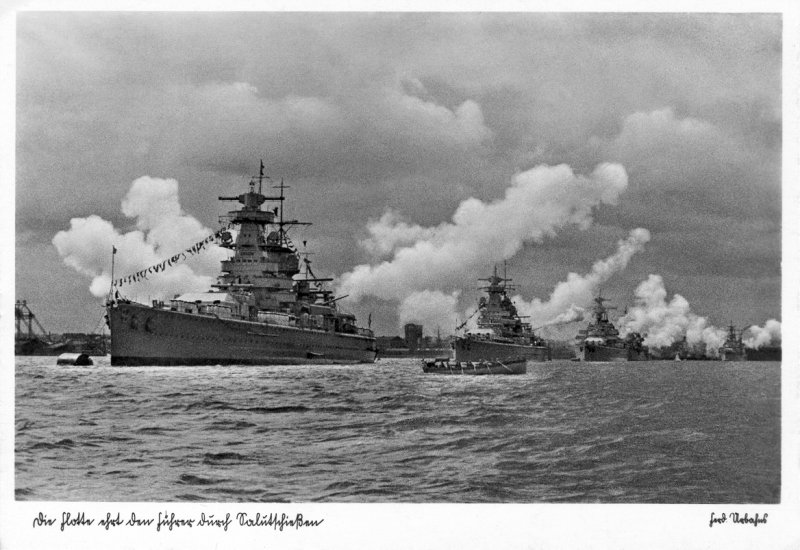
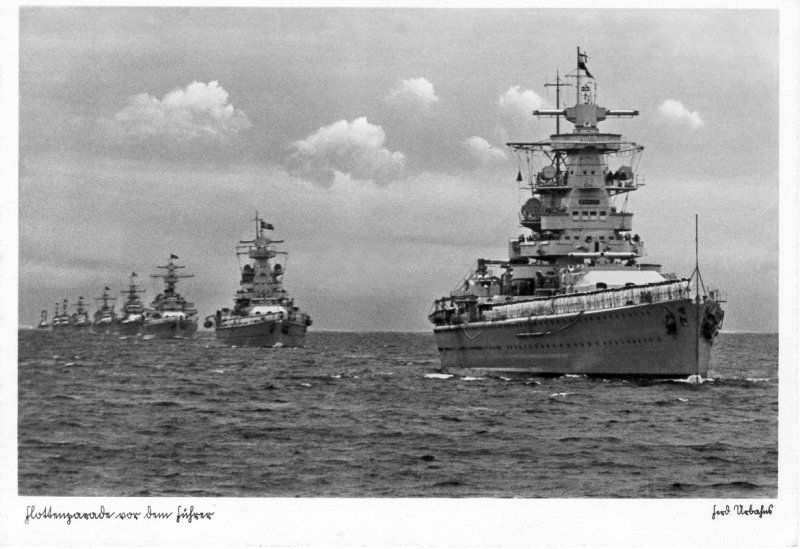
Fleet parade at Laboe.
Atlantic operations, visit to Santa Cruz.
First Spain operation.
Second Spain operation.
Third Spain operation.
The Admiral Graf Spee takes part at the international fleet parade at Spithead.
Fourth Spain operation.
Autumn maneuvers, followed by visits to Wisby and Kristiansand.
Fifth Spain operation.
Training operations in Norwegian waters.
Fleet parade at the launch of the CA Prinz Eugen.
Atlantic operations, including visit to Tangier and Vigo.
Atlantic operations, including visit to Portugal.
Flagship during the Memel-Operations.
Atlantic operations together with Deutschland, Admiral Scheer, Leipzig, Köln, Leberecht Maas, Diether von Roeder, the U-Boat tender Erwin Wasser and three U-boat flotillas, including visits to Ceuta and Lisbon.
Leaves Wilhelmshaven for the South Atlantic.
Stays 900 miles east of Bahia.
Received orders to attack allied merchant shipping.
Sinks British steamer Clement (5051 t) off Pernabuco.
Admiral Graf Spee sinks the following ships: 05.10: Newton Beach (4651 t) 07.10: Ashlea (4222 t) 10.10: Huntsman (8196 t) 22.10: Trevanion (5299 t)
Sails into the Indian Ocean and sinks British steamer Africa Shell (706 t).
Returns to the South Atlantic and sinks the following ships: 02.12: Doric Star (10086 t) 03.12: Taiora (7983 t) 07.12: Steronshaln (3895 t)
Admiral Graf Spee meets its supply ship Altmark the last time (25,5°S, 24,5°W)
The Admiral Graf Spee runs into the British CA Exeter, CL Ajax and the New Zealand CL Achilles. The Exeter is badly damaged, the other ships are hit, too. The Admiral Graf Spee (36 dead and 60 wounded) sails to Montevideo for repairs but has to leave the port in 72 hours.
Admiral Graf Spee leaves Montevideo at 6:15 pm and is scuttled in the La Plata estuary at 7:52 pm.
At a glance
Technical profile
Dimensions, armament, protection and performance.
Dimensions
- Size (Max)
- 16023 t
- Length (Total)
- 186,0 m
- Length (Waterline)
- 181,7 m
- Beam
- 21,65 m
- Draft
- 7,34 m
- Crew
- 1001-1150
Armament
- 28 cm L/52 C/28
- 6
- 15 cm L/55 C28
- 8
- 3,7 cm L/83
- 8
- 2 cm MG L/64
- 8
- 53,3 cm Torpedoes
- 8
Aircraft
- Arado Ar 196
- 2
Protection
- Deck
- 45 mm (max)
- Belt
- 80mm (max)
- Command Tower
- 150 mm
- Turrets
- 140 mm (max)
Machinery
- Shafts
- 2
- Engines
- 8
- Type
- MAN 9-cyl. diesel
Performance
- Total Performance
- 53650 shp
- Speed
- 28,5 kn
- Range
- 17460 miles at 15 kn
The archive
Photographs
Original postcard and photographic material from the private collection.
The archive
Models
Ship models in 1/1250 scale.
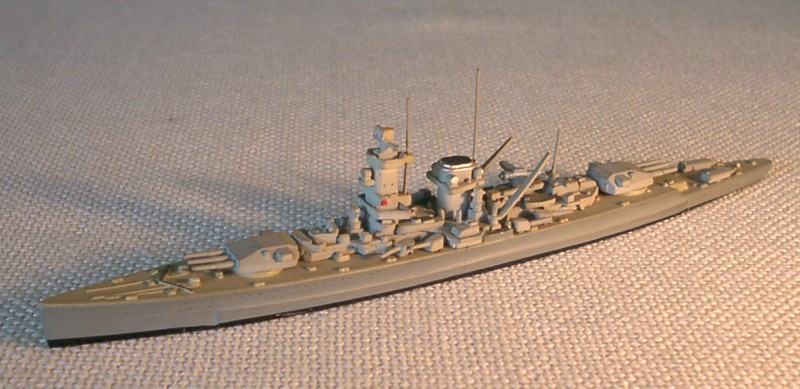
Construction record
Admiral Graf Spee
- Laid down
- Reichsmarinewerft Wilhelmshaven, 01.10.1932
- Launched
- 30.06.1934
- Commissioned
- 06.01.1936
- Fate
- scuttled 17.12.1939 (La Plate estuary)
- Cost
- 82 Mio Reichsmark