
Commissioned in Hamburg.
251,0 mOverall length
50956 tMaximum displacement
30,1 knMaximum speed
2092Complement
Design and service
The story of Bismarck
The two battleships of the Bismarck class, Bismarck and Tirpitz were the last battleships built in Germany and the most famous. The first design studies for Panzerschiff F were made as early as 1934 and showed a ship of 35000 t with eight 33 cm (13") guns. But after the construction of the second French battleship of the Dunkerque class, the naval construction department was forced to modify the previous design to build a stronger ship than the French counterparts.
From this time, the new ship was not reclassified as Schlachtschiff F (Battleship F). Officially the ship still had a size of 35000t, but in reality it was about 50% bigger, about 50000t. Although the primary mission objective for German ships was to sink allied merchant shipping, the battleships of the Bismarck class should also engage allied warships, unlike the Panzerschiffe and the Scharnhorst class.
The final design was completed by May 1935 and Schlachtschiff F (later named Bismarck) was laid down on July 1st, 1936 at Blohm & Voss in Hamburg. Its sister ship, Schlachtschiff G (later named Tirpitz) was laid down at the Kriegsmarinewerft in Wilhelmshaven in October 1936. Bismarck was completed in August of 1940, Tirpitz in February 1941.
Both ships had a totally different operational record. The Bismarck was sunk on its first operation (Operation Rheinübung) after the ship destroyed the British battlecruiser Hood. The wreck of the ship was detected in 1989, sitting upright in a depth of 4500 m.
The Tirpitz spent almost all her time in Norwegian Fjords. After the loss of all other major German ships, the last battleship of the Kriegsmarine was used as a mobile coast defense battery. After several unsuccessful attempts, the Tirpitz was finally sunk by British "Tallboy bombs.
Operational history
Service timeline
Trials in the Baltic Sea.
Last refits and construction work in Hamburg.
Trials and training in the Baltic Sea together with CA Prinz Eugen.
"Operation "Rheinübung": Escorted by the destroyers Z23, Z24, Hans Lody, Friedrich Eckoldt and the 5th M-Flotilla, Bismarck and CA Prinz Eugen leave Gotenhafen (Gdynia) for commerce raiding in the North Atlantic
While anchoring in the Korsfjord, Bismarck and Prinz Eugen are sighted by a British reconnaissance plane. Both ships leave the Fjord before British bombers can attack them.
Passing the Denmark Strait, the Bismarck and Prinz Eugen are detected by the British CA Norfolk and Suffolk. The British ships are able to shadow the Germans because of their superior Radar.
At 6 am, the British battlecruiser Hood and the battleship Prince of Wales attack the German ships. After 5 minutes, the Hood explodes in a huge detonation. Prince of Wales is hit several times, the Bismarck hit it three times, one hit cuts off the forward oil supply. The German ships head for Brest, France. Later this day, the Bismarck is attacked by torpedo planes of the British carrier Victorious. One torpedo hit but no damage.
After detected by planes of the British carrier Ark Royal, a torpedo destroys the Bismarck's rudder. The ship is unable to control its course. In the night, several British and Polish DDs attack the Bismarck, but achieved no hits.
In the morning, the British battleships Rodney and King George V attack the uncontrollable ship. After two hours the Bismarck is a burning wreck. The ship sinks after several torpedo hits by the British CA Dorsetshire and scuttling by the own crew 300 miles north west of France.
The wreck of the Bismarck is discovered in a depth of 4500 m.
At a glance
Technical profile
Dimensions, armament, protection and performance.
Dimensions
- Size (Max)
- 50956 t
- Length (Total)
- 251,0 m
- Length (Waterline)
- 241,6 m
- Beam
- 36,0 m
- Draft
- 9,9 m
- Crew
- 2092
Armament
- 38 cm L/47 C/34 (15")
- 8
- 15 cm L/55 C28
- 12
- 10.5 cm L/65 C/33
- 16
- 3,7 cm L/83
- 16
- 2 cm MG L/64
- 20
Aircraft
- Arado Ar 196
- 4
Protection
- Deck
- 80-120 mm
- Belt
- 320mm (max)
- Command Tower
- 220 - 350 mm
- Turrets
- 360 mm (max)
Machinery
- Shafts
- 3
- Turbines
- 3
- Type
- Blohm & Voß
Performance
- Total Performance
- 150170 shp
- Speed
- 30,1 kn
- Range
- 8100 miles at 16 kn, 3740 miles at 30 kn
The archive
Photographs
Original postcard and photographic material from the private collection.

The archive
Models
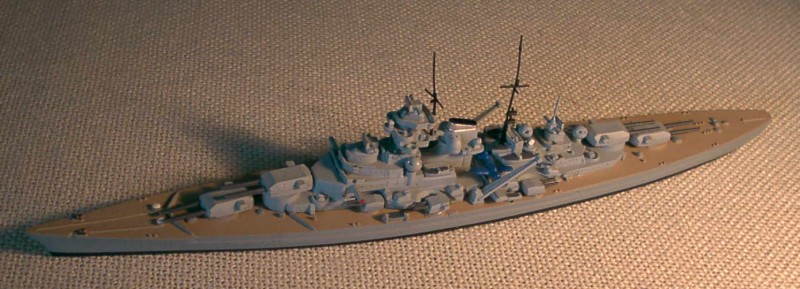
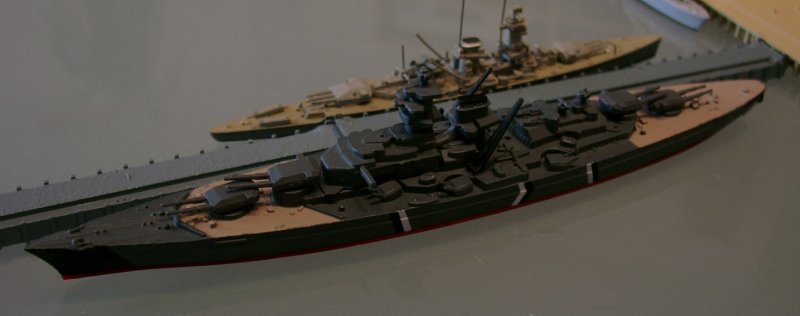
Ship models in 1/1250 scale.
Construction record
Bismarck
- Laid down
- Blohm & Voß Hamburg, 01.07.1936 (Slipway 1)
- Launched
- 14.02.1939
- Commissioned
- 24.08.1940
- Fate
- sunk 27.05.1941 (North Atlantic)
- Cost
- 197 Mio Reichsmark