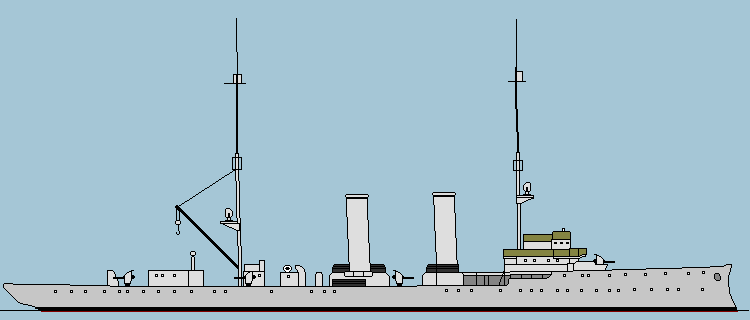
Albatross is commissioned.
Design and service
The story of Albatross
The great success of offensive mine operations in the Russian-Japanese war of 1904-1905, caused huge interest in mine warfare (and its counter measures) in most european countries. As a result, the Hochseeflotte ordered two special build mine layers - the official designation was "Minendampfer" - to replace the existing minelayers which were converted from other ships.
Although the two ordered ships were originally planned to be both of the same class, they differed so much that they could be seen as different ship classes. The first build Nautilus had the typical appearance of a yacht, while the half-sister Albatross looked more like a small cruiser.
Despite their later designation as a mine cruiser, the weak 8,8 cm guns as main artillery made those ships no real match for a real small cruiser. The maneuverable ships proved to be very sensitive to wind, especially at low speeds.
Albatross was laid down after some first experience with her half-sister was made, therefore several modifications were made which lead to complete different outer appearance. Like the Nautilus, the ships was first used in the mine training school and laid several mine fields during the war. After an engagement with a superior Russian cruiser force, the ship was beached in Swedish waters and returned to Germany after the war where it was scrapped.
Operational record
Service timeline
Recorded deployments, refits and major events from commissioning to final disposition.
Used as a mine-training ship.
Refits and modernization.
Repairs after collision with the steamer Wartburg.
Training in the Baltic Sea.
Together with the small cruiser Stuttgart and the 11th torpedo boat flotilla, the Albatross lay about 200 mines off the Tyne estuary.
Albatross and Nautilus lay a defensive minefield west of Helgoland.
About 550 mines are laid near the island of Bogskär in the northern Baltic Sea.
After another mine operation in the same area, the ship is detected by a Russian squadron consisting of the armored cruisers Admiral Makarov, Bajan and the protected cruiser Bogatyr and Oleg.
Trying to escape form the Russian ships, the Albatross heads towards neutral Swedish waters. Arrived there, the ship ceases fire, but the Russian ships continue to shoot on the German minelayer. Because of the damages on board of the ship, the commander decides to beach the ship to prevent it form capsizing. The crew is interned in Sweden, 28 members were killed during the battle.
The ship is towed to Farö.
After the war, the Albatross is towed back to Germany and arrives in Danzig.
Transferred to Kiel.
Decommissioned.
Stricken from fleet lists, the ship is scrapped after that.
At a glance
Technical profile
Dimensions, armament and performance.
Dimensions
- Size (Max)
- 2506 t
- Length (Total)
- 100,9 m
- Beam
- 11,5 m
- Draft
- 4,4 m
- Crew
- 208
Armament
- 8,8 cm L 35
- 8
- Mines
- 288
Machinery
- Shafts
- 2
- Engines
- 2
- Type
- 3-cyl triple expansion
Performance
- Total Performance
- 5963 shp
- Speed
- 20,2 kn
- Range
- 3680 miles at 9 kn
The archive
Models
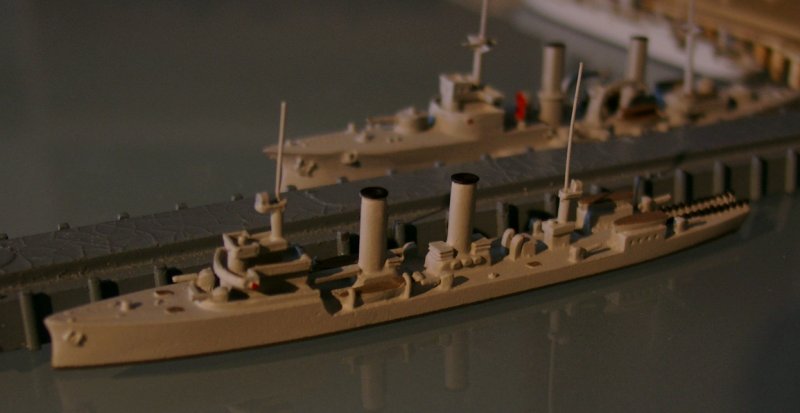
Construction record
Albatross
- Laid down
- A.G. Weser, 1907
- Launched
- 23.10.1907
- Commissioned
- 19.05.1908
- Fate
- scrapped 1921