A cruiser for colonial waters
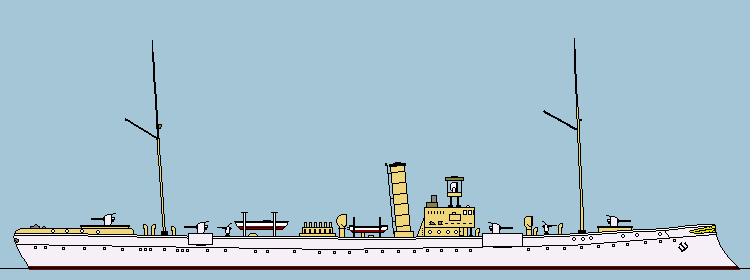
Coal endurance, sails and practical armament supported prolonged operations far beyond the North Sea fleet's infrastructure.
The full story
In the years after the French/German war of 1870/71, the German navy was looking for ships that could be used to protect the growing numbers of overseas colonies. The existing gunboats were not very useful for this, outgunned by foreign vessels, too small to store the nescessary amount of coal and not seaworth enough to operate on oceans far away from the coastal waters of Germany or the North Sea.
Therefore a new class of ships was ordered, the Kreuzer IV. Class of the Bussard class. Not build after the requirements of naval fleet battles, but specially designed ships for overseas duty. Beside their huge coal capacity, they were equipped with sails to assist the steam engines. Quite unusual for its time, the cruisers were equipped with an electrical system and a huge flashlight on top of the command bridge.
The ships were said to be good seagoing vessels, but because of their gun mountings besides the hull, they lost speed in higher seas.
The Seeadler was the third ship of this class. Originally named Kaiseradler, the cruiser was renamed Seeadler when the new Imperial yacht was given the former name. After its commissioning, the Seeadler operated 13,5 years in overseas territorys, in Africa and South-Eas Asia. This was the longest time for a German warship operating outside of Germany. After its return to Germany in early 1914, the Seeadler was not used for active duty anymore, instead it was used as a mine hulk in Wilhelmshaven. There, it was destroyed when its mine payload exploded on 19.04.1917.
Operational history
The former Kaiseradler is renamed to Seeadler before commissioned.
Training and trials.
Seeadler rams the Panzerkorvette Bayern.
Seeadler is commissioned.
Together with the Kaiserin Augusta, the Seeadler is sent to the USA for the 400 anniversary celebrations of the discorvery of America. During the Atlantic crossing, the ship runs out of coal. Since the cruiers would not arrive in time when using its sails, it had to be towed by the Kaiserin Augusta.
Arrival in Hampton Roads. After the celebrations, the ship is sent to the East African Station.
Arrival in Adan. The Seeadler meets the Schwalbe, which is replaced by the new cruiser.
Repairs in Bombay.
Arrival in Sansibar.
Together with the Möwe, the Seeadler is ordered to Kilwa Kiwindje to assist the German troops against slave traders.
Evacuation of German settlers to Sansibar.
Boiler repairs in Bombay.
Repairs in Cape Town.
Sent to Deutsch-Südwestafrika to assist the German troops there.
Seeadler returns to East Africa.
Assists the sailing ship Emile during a fire of its coal load.
Seeadler is ordered to Sansibar to assist the new Sultan of Sansibar against the British. The Sultan is brought to Daressalam.
Ordered to Lourenco Marques to support German diplomats there.
Repairs in Cape Town.
Repairs in Cape Town.
Ordered back home to Germany.
Arrival in Kiel.
Decommissioned in Danzig, reconstruction and modifiactions.
Commissioned.
Leaves Kiel for South East Asia.
Arrival in Matupi.
Sent to the Admiral Islands to investigate the murder of a trader.
Cruise thorugh the Karolinen and Marianas Islands.
Send to China.
Seeadler arrives in Tsingtau and joins the cruiser squadron.
Ordered to the Jap Island to assist the beached Mail ship München.
Repairs in Uraga.
Visit to the Philipines and Indonesia.
Ordered to East-Africa to assist in the fight against the uprising there.
Arrival in Daressalam.
Repairs in Cape Town.
Operations in East-Africa.
Repairs in Cape Town.
Sent to Deutsch Südwestafrika.
Return to Daressalam.
Seeadler is ordered back to Germany.
Arrival in Kiel.
Decommissioned in Danzig.
Reclassified as gunboat.
After the outbreak of the war, the Seeadler is not used for active duty anymore. It is transferred to Wilhelmshaven and used as a mine hulk.
The ship is destroyed after a mine explosion on board.
At a glance
Dimensions, armament, machinery and performance.
Construction record