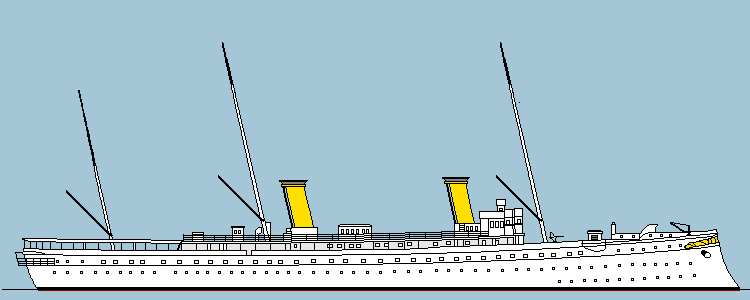
Hohenzollern is commissioned.
Design and service
The story of Hohenzollern
The German Emperor Wilhelm II was very unsatisfied with the imperial yacht Hohenzollern, an outdated paddlewheel steam ship. As it got diffucult to approve the budget for such an imperial yacht, the ship was planned as a dual usage vessel: Imperial Yacht and armed Aviso during wartime.
Also named Hohenzollern, the new yacht was put into service in 1893. Until World War I, the ship had sailed over 1600 days under the imperial flag, making various voyages with the Emperor Wilhelm II on board. On all voyages, the ship was always escorted by a warship, in most cases, this was either a small or an armored cruiser. During the War, the ship was decomissioned and not used in its intended role as an Aviso as it proved of only minimal millitary usage.
By 1913, the ship was also seen as obsolte for its usage as an imperial yacht, and a successor - twice as big as the Hohenzollern - was laid down but never completed.
Operational record
Service timeline
Recorded deployments, refits and major events from commissioning to final disposition.
Trials.
Two visits in Sweden.
Voyage to Drontheim.
Opening of the Kiel-Channel, the Hohenzollern is the first ship to make a transit. Voyages to Sweden and England.
Voyages to Italy and Norway.
Voyages to Mole, Kronstadt and Sweden.
Voyages to the Lofoten, Italy, Palestine and Pola.
Voyages to Drontheim, Bergen and England.
Voyages to Drontheim and England. During a refit, the Hohenzollern is equipped with a wireless radio.
Voyage to Britain to the funeral ceremony of the British Queen and to Mole.
Voyage ot New York. To enlarge the operational range of the ship, additional coal is stored in various rooms of the ship. Prinz Heinrich von Preussen, who wants to use this trip to visit the launch of a sailing yacht which was ordered by the Emperor in the USA, does not use the Hohenzollern for the trip, but the passenger liner Kronprinz Wilhelm.
Arrival in New York. During the time in New York, about 6000 guests visit the ship each day.
Return to Germany.
Voyages to Drontheim, Russia and Britain.
Voyages to Denmark and Drontheim.
Voyages to the Mediterranean and Drontheim.
Voyages to the Mediterranean, Denmark and Sweden.
Decomissioned for refits. All guns except two 5,2 cm ones are removed.
Recomissioned.
Voyages to the North Cape, Denmark, Great Britain and the Netherlands.
Voyages to Molde, Pola and Korfu.
Voyages to the Mediterranean, Sweden and Norway.
Voyages to Great Britain, Sweden and Norway.
Voyages to Italy, Korfu, Great Britain and Denmark.
Voyages to the Mediterranean, Baltischport and Denmark.
Voyages to Demark and Norway.
Voyages to Italy and Greece.
Despite the death of the Austrian crown prince, Kaiser Wilhelm II starts on his nordic voyage up to Balholmen.
Return to Kiel.
Hohenzollern is decomissioned. In difference to the original plans, the ship was not used during the war.
Striken form the list of warships.
Scrapped in Wilhelmshaven.
At a glance
Technical profile
Dimensions, armament and performance.
Dimensions
- Size (Max)
- 4460 t
- Length (Total)
- 122,0 m
- Length (Waterline)
- 116,0 m
- Beam
- 14,0 m
- Draft
- 6,21 m
- Crew
- 313 - 354
Armament
- 10.5 cm L/35 guns
- 3 for wartime service
- 5.2 cm L/55 guns
- 2 from 1911
- 5 cm L/40 guns
- 8, increased to 12 in wartime
Machinery
- Shafts
- 2
- Engines
- 2
- Type
- Triple expansion
Performance
- Total Performance
- 9588 shp
- Speed
- 21,5 kn
- Range
- 2520 sm at 14kn; 1260 sm at 20 kn
The archive
Models
Ship models in 1/1250 scale.
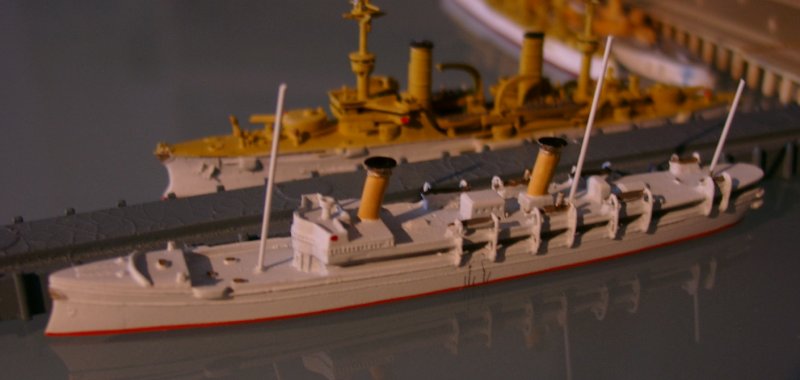
Construction record
Hohenzollern
- Laid down
- Vulcan Stettin, 1891
- Launched
- 27.06.1892
- Commissioned
- 08.04.1893
- Fate
- scrapped 1923