Dimensions
- Size (Max)
- 3858 t
- Length (Total)
- 92,85 m
- Length (Waterline)
- 85,03 m
- Beam
- 14,78 m
- Draft
- 5,38 m
Design and service
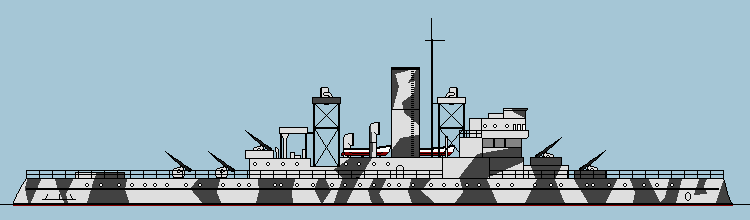
In 1940, four old coast defense ships were in service in the Norwegian navy. The two bigger ships, Norge and Eidsvold, were sunk during the German invasion of Narvik, while the two smaller ones, the Harald Haarfagre (build 1897) and the Tordenskjöld (build 1897) were captured by German forces.
Like other older and captured warships, those two ships were also modified to Floating AA batteries. After the reconstruction in Kiel, both ships entered German service an March of 1941, now named Nymphe and Thetis. Unlike other floating batteries, they kept their engine systems and were able to sail with their own power.
The Nymphe was first used in Norwegian waters near Tromsö, but later used in the area of Kiel. It survived the war, but on its way back to Norway on 17.05.1945, it beached and was later scrapped.
At a glance
Dimensions, armament and performance.
Construction record