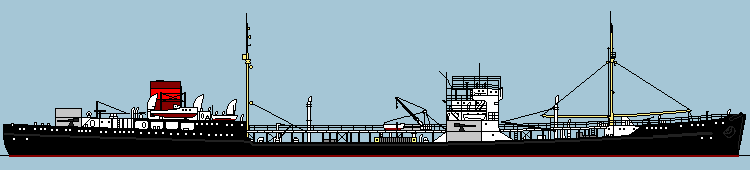
The incomplete ship is towed the Burmeister & Wain shipyard in Copenhagen to be completed there.
1943–1945Service period
Design and service
The story of Franken
Germany's lack of overseas bases made supply ships and tankers essential for sustained naval operations in the Atlantic. The Kriegsmarine trained for underway replenishment during the 1930s and employed its supply network extensively during the Spanish Civil War. In spring 1939, warships and auxiliaries, including Gneisenau, conducted a major exercise in the central Atlantic that rehearsed procedures used during the first years of World War II.
The supply network reached its greatest operational importance during Operation Rheinübung in May 1941. After the loss of Bismarck, the Royal Navy located and captured or sank many of the German support ships deployed in the Atlantic.
Alongside converted civilian tankers, the Kriegsmarine ordered the purpose-built Dithmarschen class. Five of the nine planned ships entered service. Each could carry 7,933 tons of fuel, 972 tons of ammunition, 790 tons of provisions and 100 tons of spare parts. They also carried towing equipment for assisting damaged warships.
Plans to employ the ships as auxiliary cruisers were abandoned because combat would have exposed their vulnerable cargo and replenishment equipment. Two members of the class survived the war and continued in British and United States service into the 1950s.
Franken was laid down at Germaniawerft in Kiel in December 1937, but wartime priorities delayed construction. The incomplete ship was transferred to Burmeister & Wain and completed in Copenhagen, entering service in March 1943. Operating exclusively in the Baltic, Franken supplied Prinz Eugen, torpedo boats, minesweepers and patrol craft. Soviet aircraft sank the ship near Hela on 8 April 1945, breaking the hull into two sections that remain separated on the seabed.
Operational history
Service timeline
With three years delay, the Franken is finally completed.
Supply operations in the Baltic Sea.
The Franken sinks after a heavy bomb hit near Hela which cuts the ship in two parts.
At a glance
Technical profile
Dimensions, armament, machinery and performance.
Dimensions
- Size (Max)
- 22850 t
- Length (Total)
- 179,0 m
- Length (Waterline)
- 175,0 m
- Beam
- 22,00 m
- Draft
- 10,2 m
- Crew
- 94 - 208
Armament
- 15 cm L/48 C36
- 3
- 3,7 cm Flak
- 2 (6 since 1944)
- 2 cm Flak
- 4 (16 since 1944)
- MG
- 8
Machinery
- Shafts
- 2
- Eninges
- 4
- Type
- MAN 9-cyl diesel
Performance
- Total Performance
- 24000 shp
- Speed
- 20,9 kn
- Range
- 12500 sm at 15 kn
Construction record
Franken
- Laid down
- Deutsche Werke Kiel, 1937
- Launched
- 08.03.1939
- Commissioned
- 17.03.1943
- Fate
- sunk after bomb hit on 08.04.1945