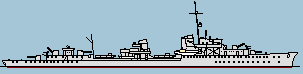
Raid to intercept Britain - Scandinavia trade together with battleship Gneisenau, CL Köln and destroyers Wilhelm Heidkamp, Erich Steinbrinck, Diether von Roeder, Max Schulz, Paul Jakobi, Bernd von Arnim, Friedrich Ihn and Friedrich Eckoldt. No results.
125,10 mOverall length
3469 tMaximum displacement
40,45 knMaximum speed
323Complement
Design and service
The story of Z20 Karl Galster
As part of the 5th destroyer division, the Z20 Karl Galster was used to lay minefields in the North Sea (Westwall) in September 1939, followed by four mine laying operation off the British coast until February 1940. Since the ship was in a shipyard during the invasion of Norway, it was the only surviving vessel of its class in April 1940 and took part in Operation Juno, together with the battlecruisers Scharnhorst and Gneisenau. Between July and September 1940 it conducted offensive minelaying in the southern North Sea and sent to France until December 1940.
After repairs the destroyer was attached to the 6th destroyer division operating in Norway until November 1941 when it returned to Kiel for major maintenance work. Back in Norway again, the ship run aground had to return to Germany again, and until Spring of 1943 the ship was often transferred between Norway and Germany. Stationed at the Alta Fjord, the ship participated in Operation Sizilien in September 1943, followed by operations in Norway and Germany.
In the final days of the war, the destroyer was part of the evacuation fleet in East Prussia and decommissioned on 10.05.1945.
The ship was added to Soviet Fleet lists on 05.11.1945 and taken over by a Russian crew on 01.02.1946. After arrived at Libau on 13.02.1946 it was renamed to Prochny and served in the South Baltic fleet between 15. 02.
1946 and 24.12.1955.
On 28.11.1954 it was renamed to PKZ-99, two days later it was reclassified as floating barrack.
The ship was removed from fleet lists on 25.06.1956 and scrapped after that.
Operational history
Service timeline
Mine laying operations together with the destroyers Wilhelm Heidkamp, Friedrich Eckold, Diether von Roeder, Hans Lüdemann and Hermann Künne against the Humber estuary.
Mine laying operations together with the destroyers Wilhelm Heidkamp, Hans Lüdemann and Hermann Künne against the Themse estuary. The returning ships are escorted by the light cruisers Nürnberg and Köln and the torpedo boats Iltis, Leopard, Seeadler and Wolf.
Mine laying operations together with the destroyers Friedrich Eckold, Friedrich Ihn, Erich Steinbrinck, Richard Beitzen and Hermann Schoemann against the Themse estuary.
Mine laying operations together with the destroyers Anton Schmitt, Wilhelm Heidkamp, Richard Beitzen, Friedrich Ihn and Friedrich Eckold against Newcastle.
Wilhelm Heidkamp and Karl Galster escort the battleships Scharnhorst and Gneisenau and the heavy cruiser Admiral Hipper during an operation against the Shetland narrow.
Participation in "Operation Juno". Together with the destroyers Hans Lody, Hermann Schoemann and Erich Steinbrinck and the torpedo boats Falke and Jaguar, the Karl Galster escorts the battleships Scharnhorst, Gneisenau and the cruiser Admiral Hipper.
Transfer of the damaged Gneisenau back to Germany, the battleship is escorted by light cruiser Nürnberg and the destroyers Hans Lody, Paul Jakobi, Friedrich Ihn and Karl Galster, the torpedo boats Iltis, Jaguar, Kondor, Luchs and T5.
Together with the destroyer Paul Jakobi and the torpedo boats Falke, Iltis, Jaguar, Kondor, T5 and T7, the Karl Galster escorts the mine layers Corba, Roland and Tanneberg while laying the mine field SW2. The mine layers carry 600 mines.
Mine laying operation SW3. Together with the destroyers Paul Jakobi and Erich Steinbrinck and the torpedo boats Falke, Greif, Iltis, Jaguar, T5, T6, T7 and T8 the Karl Galster escorts the mine layers Corba, Roland and Tannenberg. The mine layers carry about 600 mines.
The destroyer Karl Galster and the torpedo boats Falke, Greif, Ilits, Jaguar, Kondor, T1, T2 and T3 excecute a mine laying operation in the south western North Sea.
Mine laying operation SW0: The destroyer Karl Galster and the torpedo boat Kondor cover the mine laying operation of the mine layers Kaiser, Togo and the torpedo boats Greif, Falke and Iltis. The mine layers carry 405 mines while the torpedo boats about 1000 explosive buoys.
Together with Hans Lody, Theodor Riedel, Friedrich Eckold and Friedrich Ihn, Karl Galster is sent to Cherbourg.
Transfer to Brest.
Mine laying operation at Falmouth Bay together with the destroyers Friedrich Eckold, Theodor Riedel, Hans Lody, Paul Jakobi, Friedrich Ihn and Erich Steinbrinck.
Operation against the Bristol Channel together with the destroyers Friedrich Ihn, Erick Steinbrinck, Hans Lody and the torpedo boats Falke, Greif, Jaguar, Kondor, Seeadler and Wolf. Short engangement with British cruisers and destroyers.
Karl Galster, Richard Beitzen and Hans Lody operate against Plymouth. One British patrol boat and the transport Appolonia are sunk.
Karl Galster, Richard Beitzen and Hans Lody operate against Plymouth again. Three smaller British ships are sunk, the destroyer Javelin is torpedoed.
Hans Lody and Karl Galster return to Germany.
Operation Rheinübung: The destroyers Friedrich Eckold, Hans Lody, Friedrich Ihn, Erich Steinbrinck, Karl Galster and Z20 escort the battleship Bismarck and the heavy cruiser Prinz Eugen from the Baltic Sea to Trondheim. After that, the destroyers return to Germany.
Hans Lody, Friedrich Eckold, Karl Galster, Z23 and Z24 escort the damaged cruiser Lützow (airborne torpedo hit) back to Germany.
Friedrich Eckold, Karl Galster and Hermann Schoemann are sent to Bergen.
The 6th destroyer flotilla, consisting of the destroyers Friedrich Eckold, Karl Galster, Herman Schoemann, Richard Beitzen and Hans Lody are transferred to Kirkenes.
Operations of the 6th destroyer flotilla near hte North Cape and Kola: Hans Lody, Karl Galster, Hermann Schoemann, Friedrich Eckold and Richard Beitzen sink the Russian patrol boats Passat and Molotow.
The 6th destroyer flotilla, consisting of the destroyers Friedrich Eckold, Karl Galster, Herman Schoemann, and Richard Beitzen operate in the Arctic Sea and sink the Russian patrol boat Meridian and one float plane.
Karl Galster and Hermann Schoemann escort a transport from Kirkenes to Honnigsvaag.
Karl Galster and Hermann Schoemann escort a convoy from Tromsö to Kirkenes.
Karl Galster and Hermann Schoemann escort a convoy from Kirkens to Hamerfest and back.
Karl Galster and Hermann Schoemann escort a convoy from Kirkens to Tromsö.
Karl Galster and Friedrich Eckold escort a convoy from Tromsö to Kirkenes.
Karl Galster and Friedrich Eckold escort a convoy from Kirkenes to Tromsö.
Karl Galster escort a convoy from Tromsö to Loppa.
Karl Galster escort a convoy from Loppa to Tromsö.
Karl Galster escort a convoy from Tromsö to Kirkenes.
Karl Galster and Hans Lody escort a troop transport from Tromsö to Kirkenes.
Hans Lody, Friedrich Eckold and Karl Galster escort a convoy from Kirkenes to Honnigsvaag.
Karl Galster escorts a convoy from Ofotfjord to Kirkenes.
Karl Galster and Friedrich Eckold escort a convoy from Hammerfest to Kirkenes.
Karl Galster and Friedrich Eckold escort a convoy from Kirkenes to Tromsö.
Karl Galster escorts a convoy from Tromsö to Kirkenes.
Karl Galster escorts a convoy from Kirkenes to Tromsö.
Karl Galster escorts the damaged destroyer Friedrich Eckold (ramming) to Trondheim.
The destroyer is sent back to Germany.
The destroyers Karl Galster and Theodor Riedel are sent to Norway.
Operation Rösselsprung: In a major operation of the battleship Tirpitz and the heavy cruisers Admiral Scheer, Lützow and Admiral Hipper against the allied convoy PQ17, several destroyers and torpedo boats escort the capital ships: Friedrich Ihn, Hans Lody, Karl Galster, Theodor Riedel, Richard Beitzen, Friedrich Eckoldt, Erich Steinbrinck, Z24, Z27, Z28, Z29, Z30, T7 and T15. The operation is cancelled, but the convoy is heavily attacked by U-boats and the Luftwaffe. Karl Galster had to quit the operation early after running aground.
The destroyer returns to Germany.
At a glance
Technical profile
Dimensions, armament, protection and performance.
Dimensions
- Size (Max)
- 3469 t
- Length (Total)
- 125,10 m
- Length (Waterline)
- 120,60 m
- Beam
- 11,75 m
- Draft
- 4,50 m
- Crew
- 323
Armament
- 12,7 cm L/45 C/34 (5")
- 5
- 3,7 cm L/83 C/30
- 4
- 2 cm MG L/65 C/30
- 4
- 53,3 cm Torpedo tubes
- 8
- Mines
- 60
- Depth Charge launcher
- 4
Machinery
- Shafts
- 2
- Turbines
- 2
- Type
- Wagner (Deschimag build)
Performance
- Total Performance
- 74482
- Speed
- 40,45 kn
- Range
- 2050 miles at 19 kn
The archive
Photographs
Original postcard and photographic material from the private collection.
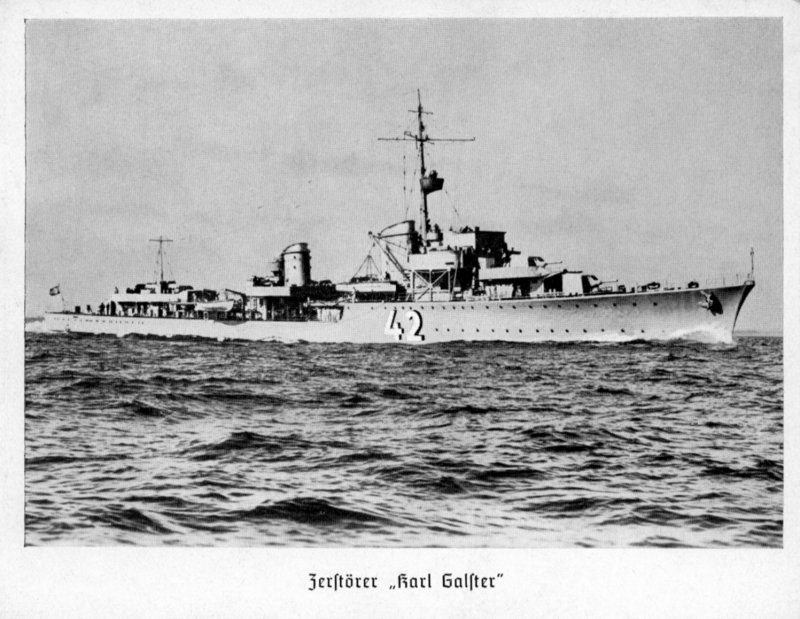
The archive
Models
Ship models in 1/1250 scale.
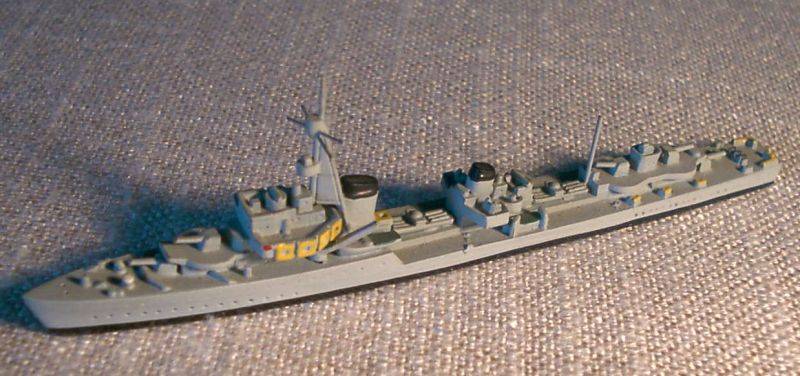
Construction record
Z20 Karl Galster
- Laid down
- Deschimag Bremen, 14.09.1937
- Launched
- 15.06.1938
- Commissioned
- 21.03.1939
- Fate
- scrapped 1956
- Cost
- 12,87 Mio Reichsmark