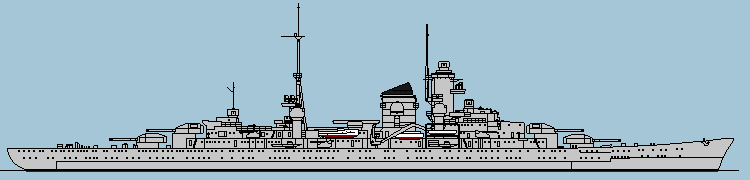
Launched at Deschimag shipyard, Bremen.
210,0 mOverall length
19800 tMaximum displacement
32,5 knMaximum speed
~1600Complement
Design and service
The story of Lützow
The Admiral Hipper class emerged from Germany's return to heavy-cruiser construction in the 1930s. Although conceived within the 10,000-ton, 20.3 cm-gun limits associated with the Washington treaty system, the completed ships were substantially larger than the nominal limit.
Five ships were laid down between 1935 and 1937. Admiral Hipper and Blücher formed the first group, while Prinz Eugen, Seydlitz and Lützow incorporated an improved design. Seydlitz and Lützow were initially considered as 15 cm-gun light cruisers, but both were reordered with 20.3 cm guns. The class was intended for commerce warfare, combining heavy armament with sufficient speed to avoid stronger opponents.
In practice, the ships' high-pressure steam machinery consumed too much fuel for sustained Atlantic operations and proved difficult to maintain. Only Admiral Hipper, Blücher and Prinz Eugen were completed as heavy cruisers; construction of Seydlitz and Lützow remained unfinished.
Lützow never entered German service. Germany sold the incomplete cruiser to the Soviet Union in 1940, and the hull was towed to Leningrad and renamed Petropavlovsk. Still only partly completed, she served as a stationary battery with four 20.3 cm guns during the defense of Leningrad. German artillery sank her in shallow water in September 1941, but she was raised and returned to action, firing on retreating German forces in 1944. Renamed Tallinn, then Dnepr and finally PKZ-112, the unfinished ship served in training and accommodation roles until she was removed from the Soviet naval register in 1958 and scrapped.
Operational history
Service timeline
Purchased by Soviet Union from Germany.
The incomplete hull is towed to Leningrad.
Renamed to Petropavlovsk.
The Petropavlovsk is completed about 70%. Machinery and subsidiary installations are incomplete, the funnel and only basic elements of superstructures are erected plus improvised main-mast mounted. Only "A" and "D" (1st and 4th) 20,3 cm (8") turrets are mounted and equipped plus bases and barbettes for the other two. AA guns consisted of two 3,7 cm and eight 20 mm guns (most likely German models)
The cruiser was re-equipped to floating battery with its four 20,3 cm guns (German ammunition) and towed to the Call Harbor (Leningrad Trade Port's area).
Petropavlovsk opens fire on Wehrmacht units. After 21st volley the barrel of the left 20, cm gun of the "A" turret broke down because of internal shell/defect which was thoroughly sealed in Germany.
The motionless ship has fired about 700 shells on German ground units. German heavy artillery fired at the cruiser. During this day Petropavlovsk received 53 hits of 210 mm shells. She sunk and set upon the bottom on shallow waters.
During operation "Eisstoss" the cruiser received one serious hit from Luftwaffe bombers.
The ship was raised and towed for refitting.
Reintegrated into the naval defence of Leningrad, moved to the "Iron Seawall" in Leningrad Cargo Port.
The ship is refitted with AA guns: six 3,7 cm L/67, 5x70-K mountings, two 20 mm and several (6-8) 12,7 mm L/79.
Petropavlovsk fires on German units retreating. Over 1036 shells were fired for 10 days.
The cruiser is renamed to Tallin.
The ship is transferred to the Baltic plant in order to continue construction.
The ship is re-classified to Light Cruiser.
Technical parameters for a completion of the i are set: 12 x 15,2 cm guns L/53 "MK-5" (in triple turrets), 6 x 10 cm guns L/70 "SM.5", 12 45 mm L/78 "SM-20" flak and 24 x 25 mm L/80 "4M-120" light Flak. The maximum size of the ship was projected to be 19395 t. But caused by the time and money to be spend on this project - equal to the construction of an additional Severdlov cruiser - the project is canceled.
Re-classified to motionless training ship Dnepr.
Re-classified to floating barrack and renamed to PKZ-112.
Removed from the Soviet navy lists.
Broken down at the Vtorchermet base in Leningrad Cargo Port.
At a glance
Technical profile
Dimensions, armament, protection and performance.
Dimensions
- Size (Max)
- 19800 t
- Length (Total)
- 210,0 m
- Beam
- 21,8 m
- Draft
- 7,9 m
- Crew
- ~1600
Armament
- 20,3cm SK (8")
- 8
- 10,5 cm L/65 C/33
- 12
- 4 cm Flak
- 20
- 3,7 cm L/83
- 8
- 2 cm MG L/64
- 32
- 53,3 cm Torpedoes
- 12
Aircraft
- Arado Ar 196
- 3
Protection
- Deck
- 12-50 mm
- Belt
- 70-80 mm
- Command Tower
- 50 - 150 mm
- Turrets
- 70 - 105 mm
Machinery
- Shafts
- 3
- Turbines
- 3
- Type
- Deschimag geared turbines
Performance
- Total Performance
- 132000 shp
- Speed
- 32,5 kn
- Range
- 8000 miles at 20 kn
Construction record
Lützow
- Laid down
- Deschimag Bremen, 02.08.1937
- Launched
- 01.07.1939
- Fate
- scrapped in the 1950s (Russia)
- Cost
- 83,6 Mio Reichsmark