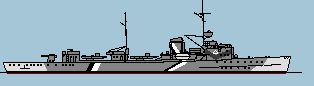
T3, T5 and T11 escort the Troßschiff Dithmarschen and the training ship Bremse from Stavangar to the German Beight.
84,30 mOverall length
1082 tMaximum displacement
35,0 knMaximum speed
119Complement
Design and service
The story of Torpedoboot T11
After operations near Jutland and mining operations in the North Sea, T11 was sent to France in September 1940 for a short time and damaged during a night raid on 19 September 1940.
After a short visit in Germany, the 2st Torpedoboot Flotilla was relocated to Norway, some of those ships supported the advance of German troops during the invasion of the Soviet union and some participated in Operation Cerberus in 1942. The remaining ships were was part of the torpedo training school in the Baltic Sea until mid 1943. From 1944, the 2nd Torpedoboot Flotilla was used for escort duties in the Baltic Sea.
T11 was handed over to Great Britain in February 1946. Given to France and renamed as Bir Hakeim, but not commissioned. Scrapped in October 1951.
Operational history
Service timeline
T2, T4, T5, T7, T8, T11 and T12 are attached to newly formed 2nd Torpedo Boat Flotilla.
Escorted by the torpedo boats T2 and T11, Hermann Schoemann returns to Germany.
T2, T5, T8 and T11 operate at the coast of Ösel and attack Soviet coastal batteries.
The destroyers Z25, Z26 and Z27 and the torpedo boats T2, T5, T7, T8 and T11 are attached to the Baltic fleet to prevent an escape of Soviet ships into the Baltic Sea.
Together with the light cruisers Emden and Leipzig, the torpedo boats T7, T8 and T11 attack coastal batteries at Sworbe.
T5, T11 and T12 transfer to St. Nazaire via the British Channel.
T2, T4, T5, T11 and T12 are transferred from St. Nazaire to Brest.
While doing trials in the Biscay, the battleship Scharnhorst is escorted by T2, T4, T5, T11 and T12.
Torpedoboats T2, T5, T11 and T12 escort the battleship Scharnhorst during trials in the Biscay.
T2, T5, T11 and T12 escort the heavy cruiser Prinz Eugen during engine tests und gunnery drills in the Biscay.
The afterward torpedo tubes are replacd with a quadruple 2 cm anit-aircraft guns.
Torpedo boats T2, T4, T5, T11 and T12 are relocated to Le Havre.
Operation "Cerberus": On board of Z29, the "Füher der Zerstöer" and the destroyers Richard Beitzen, Paul Jakobi, Hermann Schoemann, Friedrich Ihn, Z25 and the torpedo boats T2, T4, T4, T11, T13, T15, T16, T17 Seeadler, Kondor, Jaguar, Falke and iescort the battleships Scharnhorst and Gneisenau and the heavy cruiser Prinz Eugen through the Channel from Brest ot Germany.
The destroyers Z24, Z26, Z30 and the torpedo boats T11, T15 and T16 escort the heavy cruiser Admiral Hipper to Trondheim.
Paul Jakobi, Z25, T11 and T12 escort the damaged cruiser Prinz Eugen back to Germany.
At a glance
Technical profile
Dimensions, armament, protection and performance.
Dimensions
- Size (Max)
- 1082 t
- Length (Total)
- 84,30 m
- Length (Waterline)
- 82,16 m
- Beam
- 8,62 m
- Draft
- 2,94 m
- Crew
- 119
Armament
- 10,5 cm L/45 C/32
- 1
- 4 cm
- 1 (since 1944)
- 3,7 cm MG
- 2 (since 1944)
- 2 cm MG L/65 C/39
- 5-12 (12 since 1944)
- 53,3 cm Torpedo tubes
- 6 (3 since 1944)
- Mines
- 30
Machinery
- Shafts
- 2
- Turbines
- 2
- Type
- Wagner Geared Turbines
Performance
- Total Performance
- 31000 shp
- Speed
- 35,0 kn
- Range
- 1070 sm at 19 kn
Construction record
Torpedoboot T11
- Laid down
- Deschimag Bremen, 01.07.1938
- Launched
- 01.03.1939
- Commissioned
- 07.05.1940
- Fate
- scrapped October 1951
- Cost
- 7,8 Mio Reichsmark