The final pre-dreadnought design
Completed as HMS Dreadnought changed naval warfare, the class entered service already overshadowed by a new generation of capital ships.
Design and service
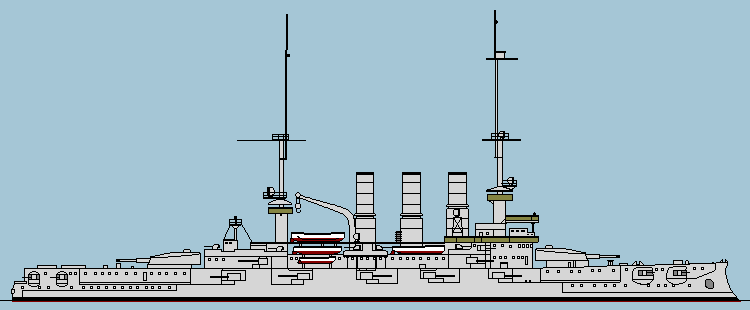
The five ships of the Deutschland class were the last pre-Dreadnougth battleships build in Germany. Based on the previous Braunschweig class, the new ships were slightly better protected, but lost a bit of the good maneuverability. The artillery of those ships was kept quite similar to the one of their predescessors.
With their old fashioned design, those ships were only use as second line battleships during World War I, but all took part in the Battle of Jutland. Because of their age those ships were among the few battleships, Germany was allowed to keep after World War I, two of them even saw action in World War II. For more information on this, see the Kriegsmarine page on Schleswig Holstein and Schlesien.
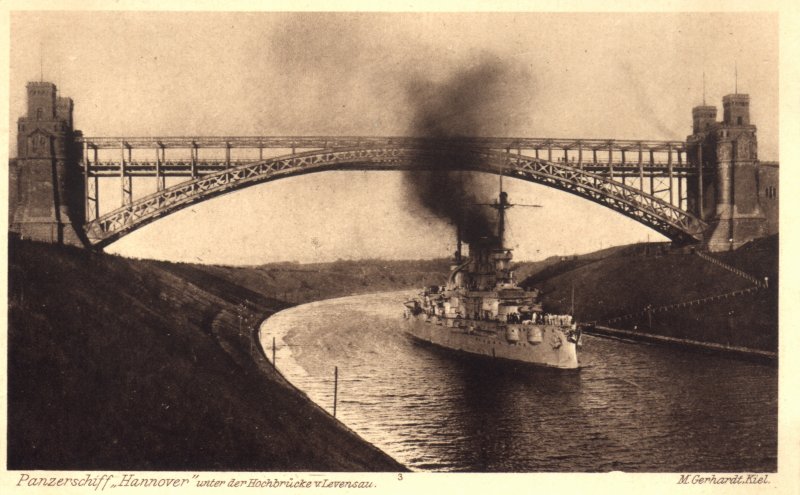
Hannover was used for fleet operation until 1917, including the Battle of Jutland. Until the end of the war, it was used as a coastal defence ship. It served in the Reichsmarine until 1935 and was used as test ship for ground mine damage evaluation after that. It was planned to modify it as a radio controlled target ship for aircraft, but this plan was abandoned. The ship was finally broken down between 1944 and 1946 in Bremerhaven.
Operational history
Hannover is commisioned.
Trials and fleet excercises in the North Sea.
Attached to the II. Squadron.
Fleet excercises in the North Sea.
Atlantic voyage, including a visit to the Azores.
Autumn fleet excercises, after that the Hannover is transferred to the I. Squadron.
Exercises in the Baltic Sea.
Fleet excercises in the North Sea.
Summer voyage to Spain.
Exercises in North and Baltic Sea.
Exercises in North and Baltic Sea.
Fleet excercises.
Transferred to Wilhelmshaven.
Exercises in the North Sea.
Summer voyage to Norway.
Exercises in the North Sea.
Exercises in the Baltic Sea.
Exercises in the North Sea.
Exercises in the North Sea.
Summer voyage to Norway.
Hannover is transferred to the II. Squadron in Kiel.
The ship becomes flagship of the II. Squadron.
Autumn fleet excercises.
Summer voyage to Norway.
Summer voyage to Norway.
Repairs.
Operations at the Doggerbank.
During the cruiser battle st the Doggerbank, the Hannover is called to assist, but is called back after a short time.
Part of the cover forces for a mine laying operation at the Swarte Bank.
Operations at the Doggerbank.
Refits in Kiel, an additional oil boiler is installed.
Unsuccesful fleet operations.
Unsuccesful fleet operations.
Part of the cover group in the operation against Lowestoft and Great Yarmouth
Battle at Jutland: As part of the 2nd Squardon, the Hannover fires 8 x 28cm and 22 x 17 cm shells and remains undamaged.
Sent to Kiel for repairs and refits, after that used as target ship in the Baltic Sea.
Some of the guns are removed.
Rebuilt as Sund-patrol ship.
Used as patrol ship at the Sund.
Decomissioned.
Modernizations in Wilhelmshaven.
Commissioned as flagship of the naval forces in the Baltic Sea.
Fleet excercises in the western Baltic Sea.
Visit to Farösund and Gotland.
Ice emergency services in the Baltic Sea.
During a night excercise, Hannover ramms the torpedo boat S18, killing 10 sailors.
Summer voyage to Finland
Visit to Stockholm.
Visit to Örnsköldsvik and Karlskrona.
Atlantic voyage.
On its way to Kiel, the Hannover collides with a buoy. With a floated engine room, the ship returns to Wilhelmshaven where it collides with the lock.
Fleet excercises in the North Sea, followed by the summer voyage to Norway, including visits to Oslo and Ulvik.
Autumn fleet excercises in the North Sea.
Voyage to the Mediterranean, visits to Palma de Mallorca, Cartagena and Vigo.
Visit to Helsingfors.
Visit to Skagen.
Atlantc voyage to Madeira, Las Palmas, St. Vincent, Santa Cruz de la Palma, Villagarcia, Amsterdam.
Decommissioned.
Recommissioned after several modernizations.
Voyage to Spain and Italy.
Fleet parade in front of Reichspräsident v. Hindenburg.
Visit to the Sognefjord and Bergen.
Autumn fleet excercises.
Decommissioned.
After the planned reconstuction as remote controlled target ship was not done, the ship was used for explosive tests and the wreck was scrapped in Bremerhaven.
At a glance
Dimensions, armament, protection and performance.
The archive
Original postcard and photographic material from the private collection.
Construction record