Turbines reshape the battle line
Steam turbines, stronger protection and an echelon turret arrangement produced faster, more capable dreadnoughts for the expanding fleet.
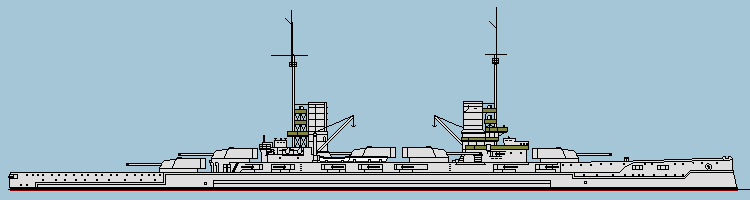
Design and service
With the construction of the third class of German Dreadnoughts several new innovations were integrated in German battleships for the first time. The main turrets were not mounted in the "Hexagon" shape anymore, instead the four midship turrets were replaced with two diagonal mounted ones.
The Kaiser class was the first turbine powered battleships of the German Navy. Although there were several doubts about the reliability of this kind of engines, a voyage by the Kaiser and König Albert to South America proved that steam turbines could be used for long distance operations. A second new feature of the engine system was the additional oil firing of the boilers, which could boost the performance. It was also planed to install a diesel engine in the Prinzregent Luitpold to test the use of diesel engines on major warships. Since the diesel engine was never build, the 4th ship of this class was only powered by the turbines on the outer shafts, no center shaft was ever installed.
All four ships operated together in the 3rd Battleship Squadron almost all the time and took part in the Battle of Jutland, where the Kaiser was slightly damaged. All were scuttled at Scapa Flow, raised in the 1930s and broken down.
At a glance
Dimensions, armament, protection and performance.
Construction record