Built under the Naval Laws
The class translated Germany's expanding naval program into five balanced pre-dreadnoughts intended for concentrated service with the battle fleet.
Design and service
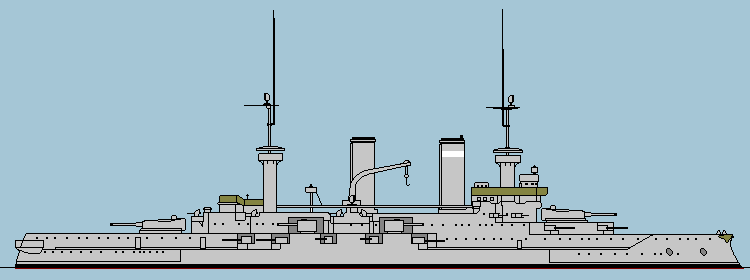
The Wittelsbach class formed part of the major German fleet-building program begun in the final years of the 19th century. Similar in armament and armor protection to the preceding Kaiser Friedrich III class, these ships and their immediate successors formed the core of the German battle fleet until the arrival of the Nassau-class dreadnoughts in 1909.
Although highly maneuverable, the ships were already outdated at the outbreak of World War I and saw active service only during its early years. All five remained in fleet service until 1916. Schwaben served primarily as an artillery training ship until Wettin assumed that role in 1911 and retained it until 1914. Wittelsbach and Schwaben later served as fleet tenders and were converted in 1919 into depot ships capable of carrying twelve small fast attack boats. Both were broken up after only two years in this role.
Operational history
While being still under construction, the ship is rammed by the Linienschiff Baden, causing some substantial damage.
Wittelsbach is commissioned.
In dense fog, the Wittelsbach runs aground near Kiel. It took 7 days until the ship was freed again and towed into a shipyard in Kiel.
Decommissioned, used as fleet reserve.
Recommissioned.
Fleet exercises.
Wittelsbach transports a statue to Norway which was presented as a gift ot the Norwegian people. It is still existing near Vangnaes today.
Attached to the training squadron.
With the outbreak of World War I, the Wittelsbach is assigned to the 4th Squadron stationed in the Baltic Sea.
Operations in the Baltic Sea to assist the beached cruiser Magdeburg.
Sent to the North Sea.
Operations in the Baltic Sea.
Patrol duty in the North Sea.
Repairs in Wilhelmshaven.
Several operations in the Baltic Sea to assist the German Army. The Wittelsbach is equipped with a third false funnel to make the ship look like the stronger Braunschweig class.
Patrol duty in the North Sea.
Transferred to Danzig.
Wittelsbach runs aground, but comes free again under its own power without any damage.
Several operations in the Baltic Sea.
Operations near Gotland.
Sent back to Kiel.
Wittelsbach is decommissioned.
A plan to modify the ship to a target ship is cancelled.
After reconstruction, the Wittelsbach is recommissioned as mother ship for small mine hunters.
Decommissioned.
Sold and scrapped.
At a glance
Dimensions, armament, protection and performance.
The archive
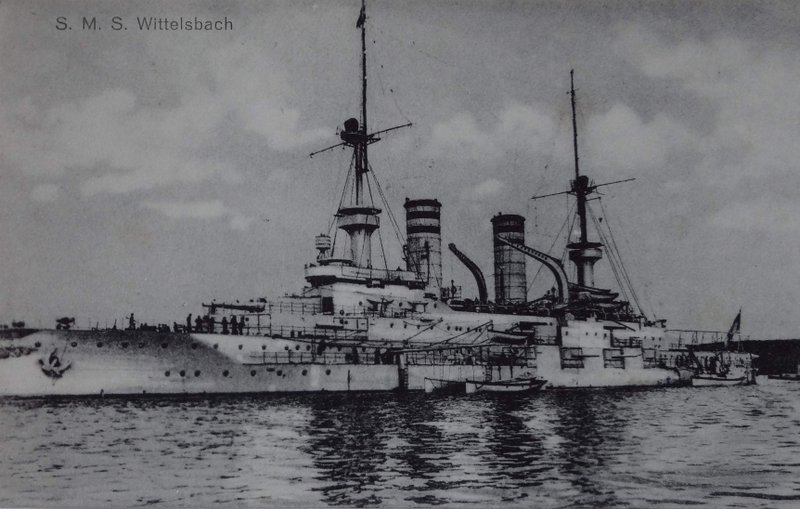
Original postcard and photographic material from the private collection.
Construction record