Armored guardians of the German coast
Heavy guns, shallow draft and compact dimensions produced ships intended to defend naval bases and strategic approaches in the North Sea and Baltic.
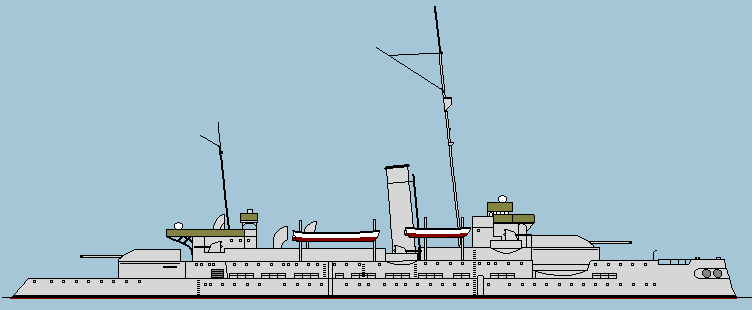
Design and service
The coast defence ships of the Siegfried class were the first real capital warships build in Germany and the last before Kaiser Wilhelm II came into power and started the huge naval construction program. With their three 24 cm guns, those ships were not armed very heavily, but they were the first German warships that carried their main artillery in closed gun turrets. The last two ships of the class, Odin and Ägir had some minor modifications and different armor protection, but besides that, all eight ships were very similar. Because of their rolling movements through the seas, those ships got the nickname "Meerschweinchen" - guinea-pig. Shortly after the beginning of the new century, all ships were modified in a major reconstruction, a second funnel and enlarged hull were the most obvious changes, and with their new coal storage's, their range was almost doubled. During World War I, those old ships were still used for coastal defence, and all of them survived the war. As they were too old for further military services most of them were scrapped while a few were converted in to civilian transport ships.
The Frithjof was used for fleet service until 1903. In 1914, the ship returned to fleet service and was used for coastal defence for two years. In 1916 it was used as a floating barrack. 1919 it was sold and in 1923 converted into a civilian transport as which it served another seven years.
Operational history
First tests and trials.
Frithjof is commissioned.
Attached to the Reserve Division North Sea.
Fleet maneuvers.
Participation in the autumn fleet maneuvers.
Frithjof takes part in regular spring and autumn fleet maneuvers.
Visit to Denmark.
Attached to the 2nd Squadron.
Decommissioned because of a major reconstruction. The ship is cut into two pieces and a additional segment is added.
Recommissioned and attached to the 2nd Squadron.
Voyage to the Shetland Islands.
Attached to the training squadron.
Training in the Baltic Sea.
Autumn fleet maneuvers.
Maneuvers in the Danzig Beight.
During the autumn maneuvers, the Frithjof rams the small cruiser Nymphe.
Decommissioned.
At the outbreak of World War I, Frithjof is attached to the 6th Squadron.
Sent into the North Sea.
The ship is used for patrol services at the Ems river.
Used as a floating barrack.
Sold to Arnold Bernstein shipping line where the ship was converted into a freighter. All guns engines and armor are removed, and replaced with two U-boat engines.
Scrapped.
At a glance
Dimensions, armament, protection and performance.
Construction record