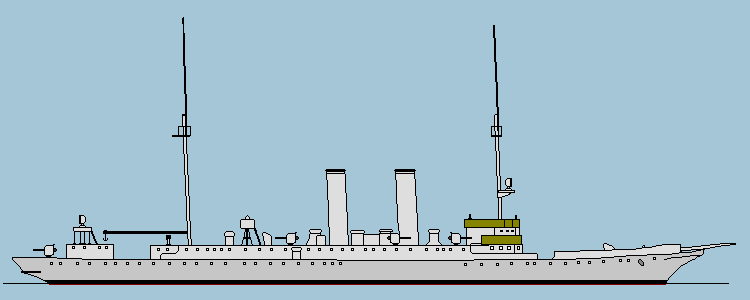
Nautilus is commissioned.
Design and service
The story of Nautilus
The great success of offensive mine operations in the Russian-Japanese war of 1904-1905, caused huge interest in mine warfare (and its counter measures) in most european countries. As a result, the Hochseeflotte ordered two special build mine layers - the official designation was "Minendampfer" - to replace the existing minelayers which were converted from other ships.
Although the two ordered ships were originally planned to be both of the same class, they differed so much that they could be seen as different ship classes. The first build Nautilus had the typical appearance of a yacht, while the half-sister Albatross looked more like a small cruiser.
Despite their later designation as a mine cruiser, the weak 8,8 cm guns as main artillery made those ships no real match for a real small cruiser. The maneuverable ships proved to be very sensitive to wind, especially at low speeds.
Only two years after being commissioned, the Nautilus was modernized based on the latest knowledge of mine warfare. It was used to train and experiment with mine warfare before the war, during the war it operated in North and Baltic Sea and laid several mine fields. It was scrapped in 1928.
Operational record
Service timeline
Recorded deployments, refits and major events from commissioning to final disposition.
Attached to the mine-testing-commando.
Used for fleet service and as a training ship for mine laying operation.
Decommissioned.
Reconstruction at Kaiserliche Werft Kiel.
Recommissioned, again used as a mine training ship.
Refits and repairs.
Used as mine experimental ship.
Used as mine experimental ship in the North and Baltic Sea.
Recommissioned.
Nautilus lays the Lister Tief-Sperre.
Another minefield: Vortrapp Tiefsperre and Norder Hever-Sperre.
Covered by the small cruiser Mainz, Nautilus lays a mine field 20 miles off the Humber.
Together with the Albatross and Kaiser, Nautilus lays an defensive minefield "alpha" in the western part of the German Beight.
Another mine operation close to the Firth of Forth is canceled when several enemy ships are reported to close to the German ships.
Nautilus lays the Gjedser Riff-Sperre.
Send to the Baltic Sea.
The ship takes part in the operations at the Baltic Islands.
Patrol operations near the Aaland Islands.
Decommissioned.
Stricken from fleet lists.
Used as hulk and renamed to Hulk 1.
Renamed to Hulk A.
Scrapped in Copenhagen.
At a glance
Technical profile
Dimensions, armament and performance.
Dimensions
- Size (Max)
- 2345 t
- Length (Total)
- 100,9 m
- Beam
- 11,2 m
- Draft
- 4,54 m
- Crew
- 201
Armament
- 8,8 cm L 35
- 8
- 2 cm
- 2
- Machine guns
- 24
- Mines
- 186 + 205
Machinery
- Shafts
- 2
- Engines
- 2
- Type
- 3-cyl triple expansion
Performance
- Total Performance
- 6638 shp
- Speed
- 20,8 kn
- Range
- 3530 miles at 9 kn
The archive
Models
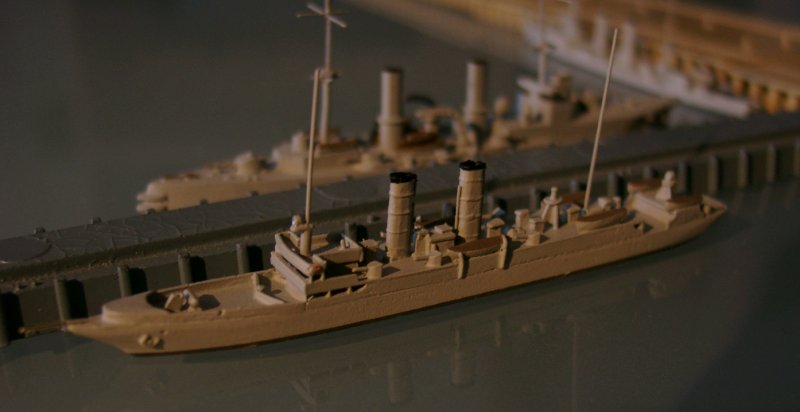
Construction record
Nautilus
- Laid down
- A.G. Weser, 1905
- Launched
- 28.08.1906
- Commissioned
- 19.03.1907
- Fate
- scrapped 1928