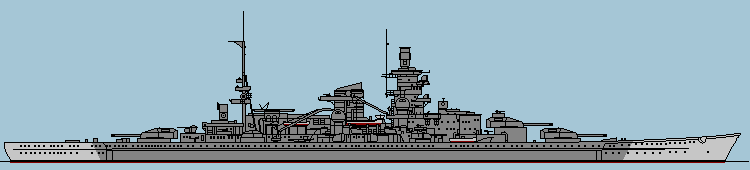
Commissioned, first trials in the Jade estuary.
229,8 m (234,9 m since 1939)Overall length
38900 tMaximum displacement
31,65knMaximum speed
1669 - 1840Complement
Design and service
The story of Scharnhorst
After the construction of the first three Panzerschiffe (Panzerschiff A-C: Deutschland, Admiral Scheer and Admiral Graf Spee) various plans for their successors were made. Projects ranged from only slightly modified designs, increased main artillery (like 30 cm guns), ships that later could refitted with a third turret or Panzerschiffe with steam engines. The developers first weren't allowed to increase the size of the ships, so all projects sooner or later lead into a quite similar design as the older Panzerschiffe.
Only after a significant grow in size was allowed, the final development of the Scharnhorst class started. Although often called "battlecruisers", those ships were officially labeled as "battleships". In difference to the Panzerschiffe a high-pressure steam engine was chosen for these ship to give them a much higher speed but since those engines never worked without any problems later operations were often negatively influenced by them.
Their main artillery was increased by 50%, but unlike other foreign battleships, the Scharnhorst class got only the small caliber guns of the Panzerschiffe. The decision for those guns was made because those guns were already in production and at this time no bigger gun was developed. To complete the ships in the planned time, the 28cm (11") guns had to be used.
But the construction of the turret mountings allowed it to replace the 28cm triple turrets with 38 cm (15") twin turrets. It was planned to do this conversion after the construction of the next generation of battleships (Battleship F & G) in 1940, but the start of the war prevented this. Battleship D, later called Scharnhorst, was laid down in May 1935 at the Kriegsmarine Shipyard in Wilhelmshaven and commissioned in January 1939.
The sister ship Gneisenau (Battleship E) was laid down in March 1935 at the Deutsche Werke in Kiel and commissioned in May 1938. It soon became clear that the straight bow of the ships had to be modified because of the amount of water taken over at high speed. During the war, both ships operated together most time.
They did a successful North Atlantic operation, and were the only battleships that sink a operational fleet carrier.
Operational history
Service timeline
Final construction in Wilhelmshaven, bow is modified.
Together with Scharnhorst, the Gneisenau is sent south of Iceland to attack the Northern Patrol.
The two battlecruisers sink the British auxiliary cruiser Rawalpindi.
Returns to Kiel.
Operation "Nordmark": Scharnhorst, Gneisenau, CA Admiral Hipper and the destroyers Wolfgang Zenker, Wilhelm Heidkamp and Karl Galster are sent to intercept British convoys between Bergen and England, but no ships are sighted.
Operation "Weserübung": Scharnhorst and Gneisenau cover the invasion of Narvik. West of the Lofoten, they engage the British BC Renown and the cruiser Birmingham in bad weather.
Operation "Juno": Flagship in the Polar Sea operations together with Gneisenau, Admiral Hipper and the destroyers Karl Galster, Hans Lody, Erich Steinbrink and Hermann Schoemann.
Battle with British CV Glorious and the DDs Ardent and Acasta. All British ships are sunk, the Scharnhorst was hit by a torpedo of the DD Acasta, damaging middle and starboard engine and Turret Cäsar.
Return to Drontheim.
After emergency repairs in Drontheim, the Scharnhorst is sent back to Kiel. Unsuccessful air attacks by the RAF.
First unsuccessful attempt to break out in the North Atlantic together with the Gneisenau. Operation is aborted after the Gneisenau is damaged by heavy seas.
Operation "Berlin": Start of successful Atlantic operation
Scharnhorst and Gneisenau break through the Denmark Strait.
Convoy HX-108 is sighted but the attack is stopped after the BB Ramiles is detected covering this convoy. Scharnhorst unsuccessfully tries to pull the British BB away of the convoy to enable the Gneisenau to attack the unprotected merchants.
Disengage from Convoy SL-67 after the sighting of the British BB Malaya.
Scharnhorst and Gneisenau attack a convoy south-east of Newfoundland.
Both ships enter Brest. They sank 22 ships with 115600 t during their North Atlantic Operations. Scharnhorst sinks 8 of them with 49300t.
Stationed in Brest, target of many British air attacks. Scharnhorst is hit by 5 bombs while temporarily anchored in La Pallice which cause severe damage.
Operation "Ceberus": Flagship during the escape the English Channel: Scharnhorst, Gneisenau and CA Prinz Eugen, escorted by 6 destroyers (Paul Jakobi, Richard Beitzen, Friedrich Ihn, Hermann Schoemann, Z25, Z29) and 14 torpedo boats (e.g. Kondor, Jaguar, T12, T13), return to Germany.
In the third attempt, the Scharnhorst sails to northern Norway and is stationed in the West Fjord/Alta Fjord.
Operation "Sizilien": A squadron consisting of Tirpitz, Scharnhorst and 9 destroyers (Erich Steinbrink, Karl Galster, Hans Lody, Theodor Riedel, Z27, Z29, Z30, Z31, Z33) attack the enemy base on Spitzbergen.
Scharnhorst is first stationed in the Kaa Fjord, then in the Lang Fjord.
Under the command of Conter-Admiral Bey, the Scharnhorst and destroyers Z29, Z30, Z33, Z34 and Z38 tries to find and attack the convoy JW-55B on its way to Murmansk. The Scharnhorst is detected by British Cruisers after she left her escorts. After several attempts, the British battleship Duke of York locates the Scharnhorst.
After several hours, the Scharnhorst is sunk at 7:45 pm. Only 36 crew members survive.
At a glance
Technical profile
Dimensions, armament, protection and performance.
Dimensions
- Size (Max)
- 38900 t
- Length (Total)
- 229,8 m (234,9 m since 1939)
- Length (Waterline)
- 226,0 m
- Beam
- 30,0 m
- Draft
- 9,9 m
- Crew
- 1669 - 1840
Armament
- 28 cm L/51 C/34 (11")
- 9
- 15 cm L/55 C28
- 12
- 10,5 cm L/65 C/33
- 14
- 3,7 cm L/83
- 16
- 2 cm MG L/64
- 10
- 53,3 cm Torpedoes
- 6
Aircraft
- Arado Ar 196
- 3
Protection
- Deck
- 80-95 mm
- Belt
- 350 mm (max)
- Command Tower
- 350 mm (max)
- Turrets
- 360 mm (max)
Machinery
- Shafts
- 3
- Turbines
- 3
- Type
- BBC
Performance
- Total Performance
- 161764shp
- Speed
- 31,65kn
- Range
- 9020 miles at 15 kn
The archive
Photographs
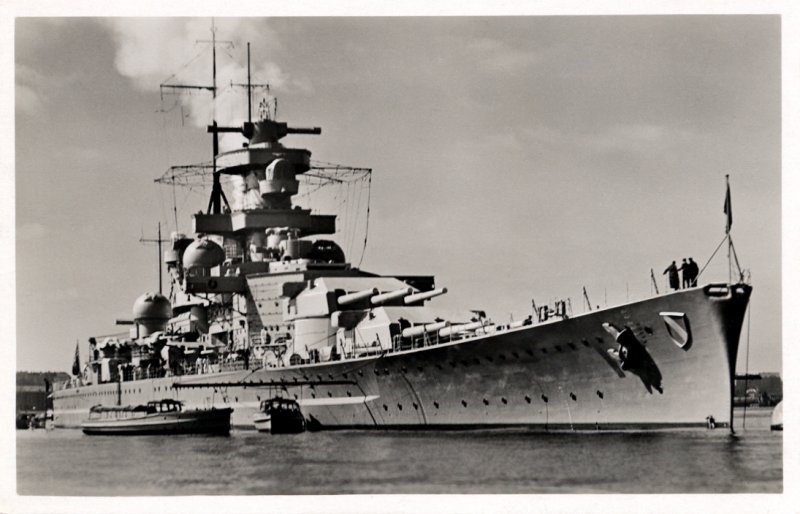
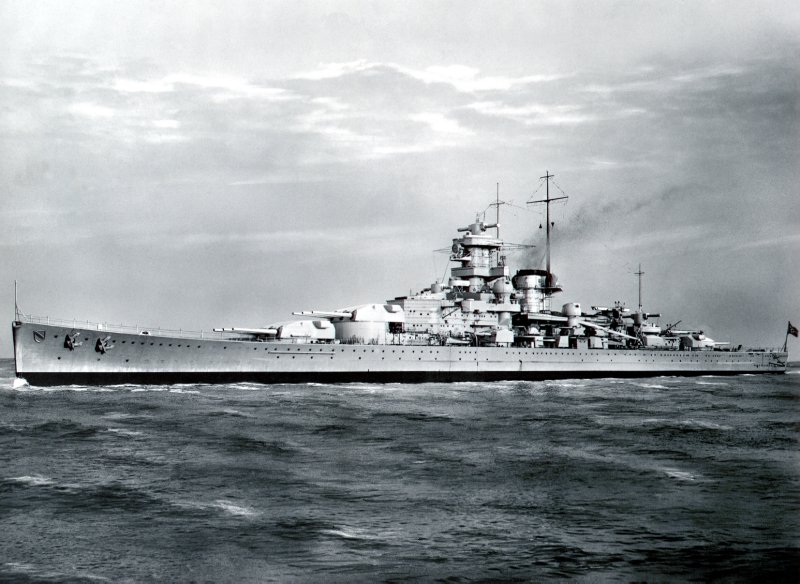
Original postcard and photographic material from the private collection.
The archive
Models
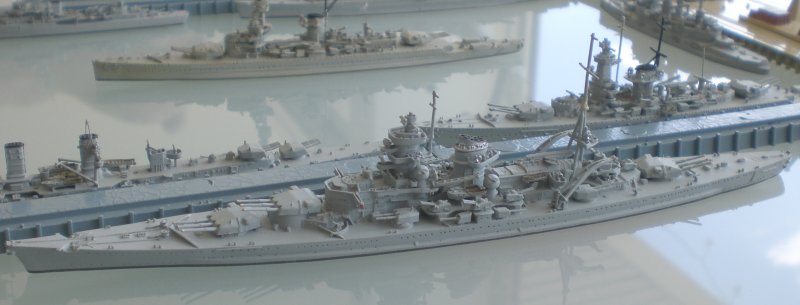
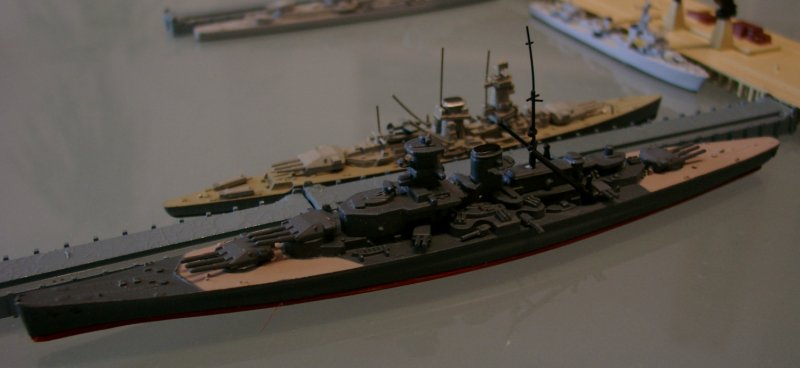
Ship models in 1/1250 scale.
Construction record
Scharnhorst
- Laid down
- Kriegsmarinewerft Wilhelmshaven, 15.06.1935 (Slipway 2)
- Launched
- 03.10.1936
- Commissioned
- 07.01.1939
- Fate
- sunk 25.12.1943 (North Cape)
- Cost
- 143 Mio Reichsmark