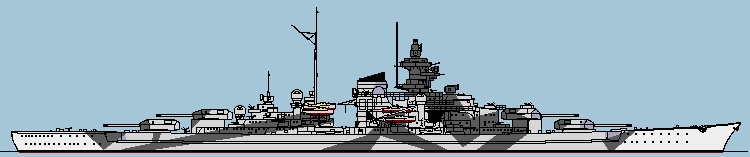
Commissioned.
251,0 mOverall length
52600 tMaximum displacement
30,8 knMaximum speed
2608Complement
Design and service
The story of Tirpitz
The two battleships of the Bismarck class, Bismarck and Tirpitz were the last battleships built in Germany and the most famous. The first design studies for Panzerschiff F were made as early as 1934 and showed a ship of 35000 t with eight 33 cm (13") guns. But after the construction of the second French battleship of the Dunkerque class, the naval construction department was forced to modify the previous design to build a stronger ship than the French counterparts.
From this time, the new ship was not reclassified as Schlachtschiff F (Battleship F). Officially the ship still had a size of 35000t, but in reality it was about 50% bigger, about 50000t. Although the primary mission objective for German ships was to sink allied merchant shipping, the battleships of the Bismarck class should also engage allied warships, unlike the Panzerschiffe and the Scharnhorst class.
The final design was completed by May 1935 and Schlachtschiff F (later named Bismarck) was laid down on July 1st, 1936 at Blohm & Voss in Hamburg. Its sister ship, Schlachtschiff G (later named Tirpitz) was laid down at the Kriegsmarinewerft in Wilhelmshaven in October 1936. Bismarck was completed in August of 1940, Tirpitz in February 1941.
Both ships had a totally different operational record. The Bismarck was sunk on its first operation (Operation Rheinübung) after the ship destroyed the British battlecruiser Hood. The wreck of the ship was detected in 1989, sitting upright in a depth of 4500 m.
The Tirpitz spent almost all her time in Norwegian Fjords. After the loss of all other major German ships, the last battleship of the Kriegsmarine was used as a mobile coast defense battery. After several unsuccessful attempts, the Tirpitz was finally sunk by British "Tallboy bombs.
Operational history
Service timeline
Trials and training in the Baltic Sea.
Tirpitz and Admiral Scheer transfer from Wilhelmshaven to Drontheim.
The destroyers Richard Beitzen, Bruno Heinemann, Paul Jakobi and Z29 escort the battleship Tirpitz to the Trondheimfjord.
Operation "Sportpalast": First combat action against allied convoys. The ship sails into the Arctic Ocean to intercept the convoys PQ-8 and PQ-12. After unsuccessful attacks by British carrier aircraft and submarines, the Tirpitz sails into the Bow Beight near Narvik.
Operations against the convoys PQ 17 and QP 13 are canceled after the breakdown of several supporting units. During this operation, the Tirpitz is attacked by the Russian submarine K21. While the Russians claim a hit on the battleship, the Germans did not notice any attack.
Richard Beitzen, Friedrich Eckoldt, Z23, Z28 and Z29 escort the battleship Tirpitz and the heavy cruiser Admiral Scheer from Narvik to Trondheim.
Docked in the Loo Fjord.
Transferred to the Bow Beight and later to the Ka Fjord.
Operation "Sizilien": A squadron consisting of Tirpitz, Scharnhorst and 9 destroyers (Erich Steinbrink, Karl Galster, Hans Lody,Theodor Riedel, Z27, Z29, Z30, Z31, Z33) attack the enemy base on Spitzbergen.
The Tirpitz is attacked by British midget submarines X5, X6 and X7. They break through the torpedo nets and X6 manages to place a mine below the ship. All midget subs are destroyed but the exploding mine causes heavy damage on board of the Tirpitz: Besides some hull damage, the turbines are put out of action, the propeller shafts and rudder are disabled.
Repairs.
Attacked by several waves of carrier aircraft. The Tirpitz is hit by 15 bombs.
Another air attack, this time the ship is only hit by one bomb, but it was the first and only time that the armored deck are penetrated.
Several unsuccessful air attacks.
Attacked by a squadron of four-engined long range bombers stationed in Russia. One bomb hit on the bow. The Tirpitz is out of action.
Transferred to the Sande Sound, the ship is only able to make 8 kn.
A squadron of 32 Lancaster bombers attack the ship with "Tallboy" bombs. After the first three hits and several near misses the ship capsizes, the magazine of one 38 cm (15") turret detonates.
The wreck of the Tirpitz is scrapped.
At a glance
Technical profile
Dimensions, armament, protection and performance.
Dimensions
- Size (Max)
- 52600 t
- Length (Total)
- 251,0 m
- Length (Waterline)
- 241,6 m
- Beam
- 36,0 m
- Draft
- 10,6 m
- Crew
- 2608
Armament
- 38 cm L/47 C/34 (15")
- 8
- 15 cm L/55 C28
- 12
- 10.5 cm L/65 C/33
- 16
- 3,7 cm L/83
- 16
- 2 cm MG L/64
- 16-58
- 53,3 torpedo tubes
- 8
Aircraft
- Arado Ar 196
- 4
Protection
- Deck
- 80-120 mm
- Belt
- 320mm (max)
- Command Tower
- 220 - 350 mm
- Turrets
- 360 mm (max)
Machinery
- Shafts
- 3
- Turbines
- 3
- Type
- Brown, Boveri & Cie
Performance
- Total Performance
- 163026 shp
- Speed
- 30,8 kn
- Range
- 8870 miles at 19kn
The archive
Photographs
Original postcard and photographic material from the private collection.
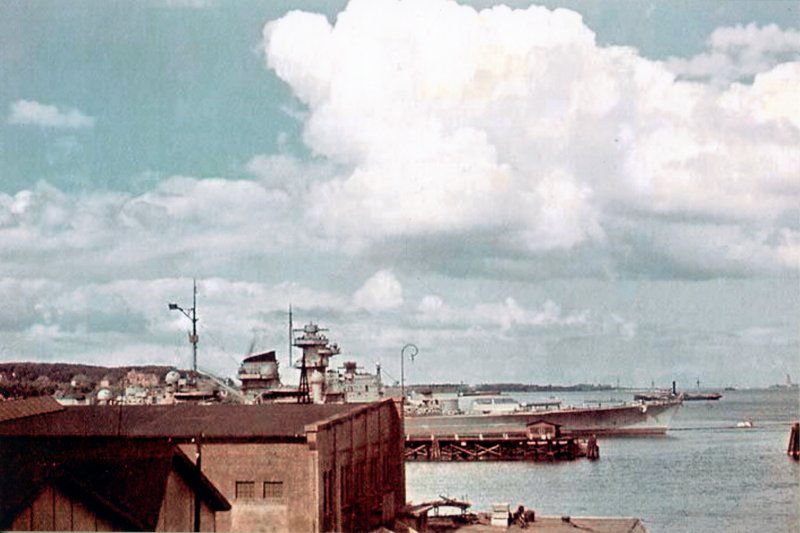
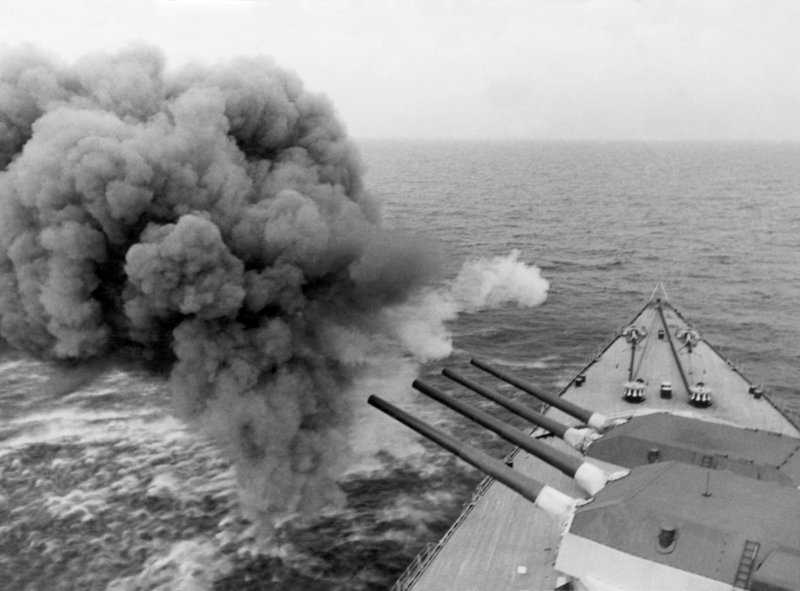
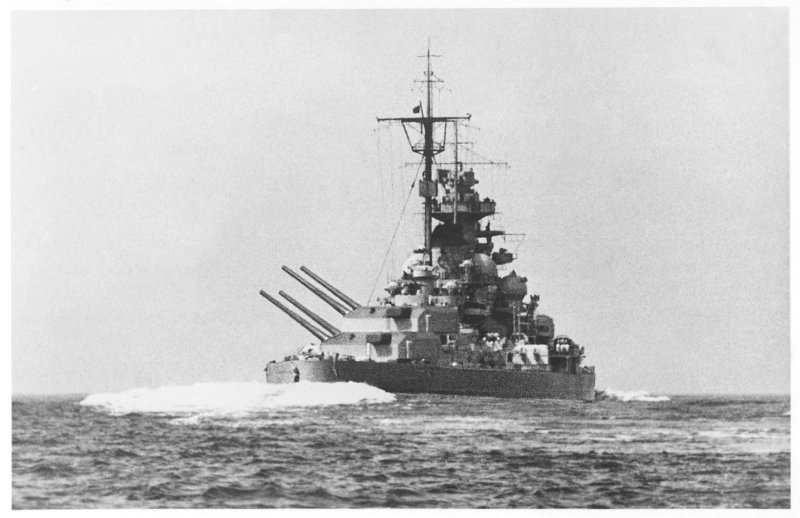
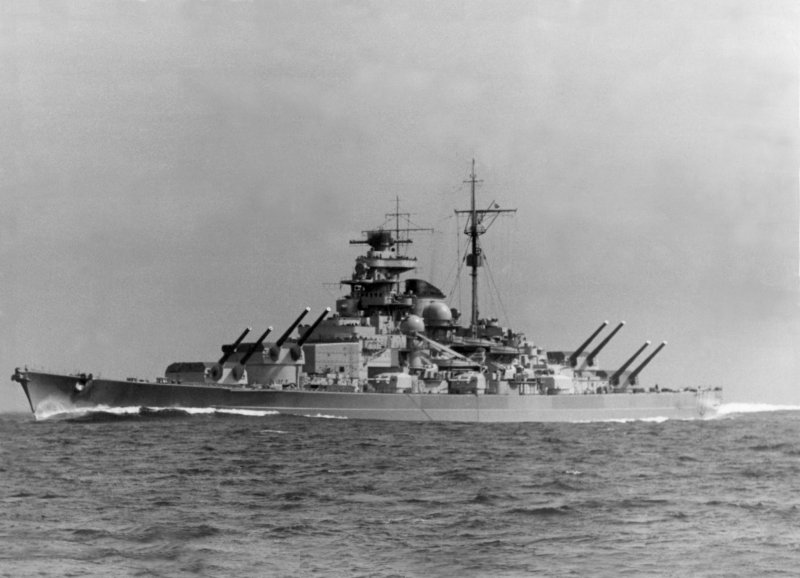
The archive
Models
Ship models in 1/1250 scale.
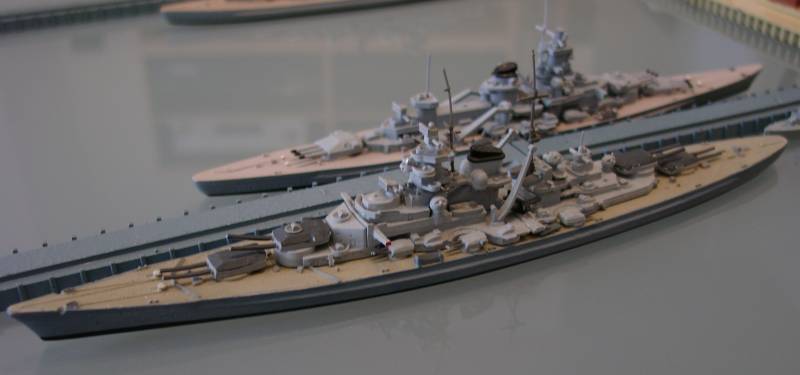
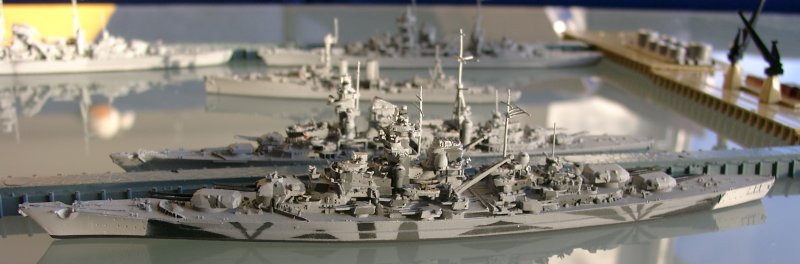
Construction record
Tirpitz
- Laid down
- Kriegsmarinewerft Wilhelmshaven 02.11.1936 (Slipway 2)
- Launched
- 01.04.1939
- Commissioned
- 25.02.1941
- Fate
- sunk 12.11.1944 (Norway)
- Cost
- 181 Mio Reichsmark