Dimensions
- Size (Max)
- 23200 t
- Length (Total)
- 262,5 m
- Length (Flightdeck)
- 244,5 m
- Beam
- 27,0 m
- Draft
- 7,6 m
Design and service
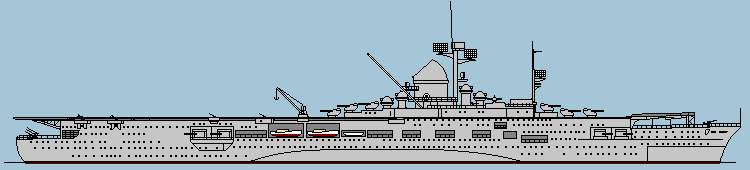
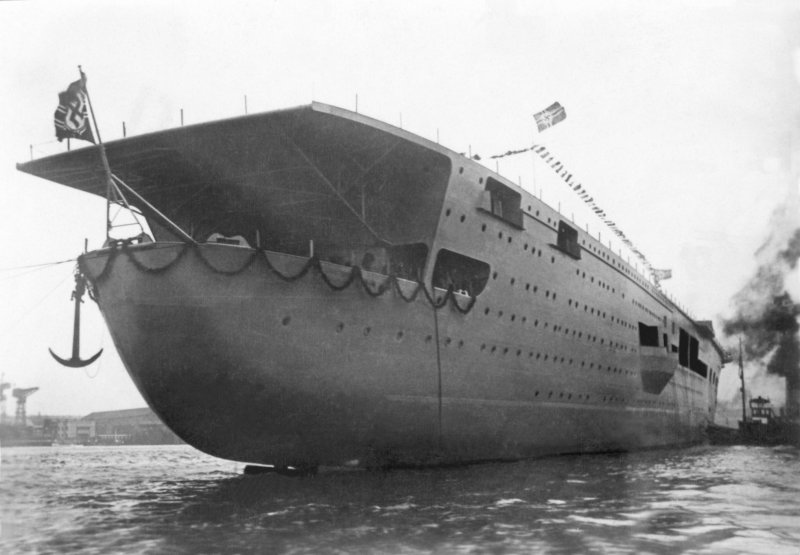
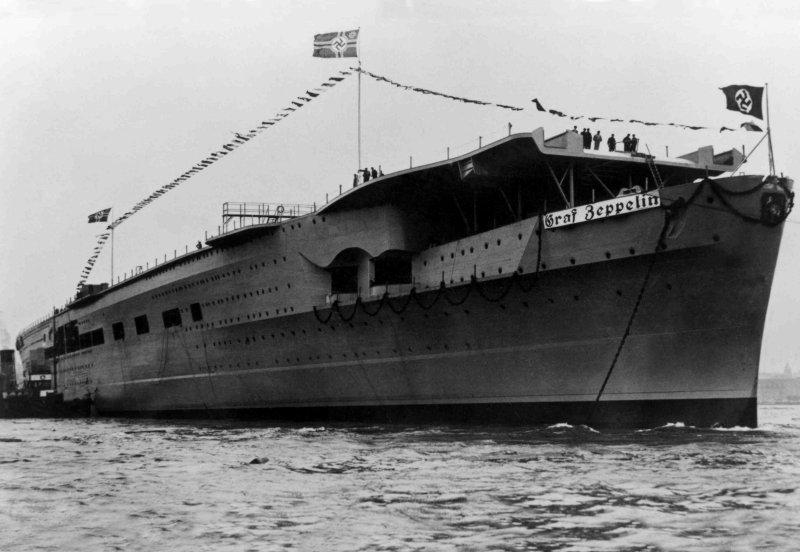
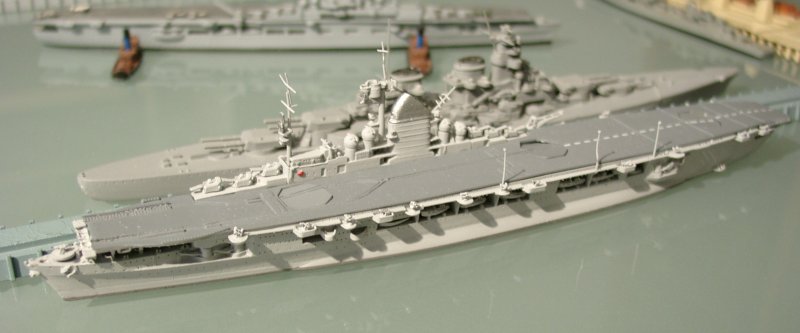
The Graf Zeppelin was Germanys only aircraft carrier in World War II - but it was never completed and never saw action. The ship was laid down on December 28th 1936 at Deutsche Werke shipyard in Kiel as Flugzeugträger "A" and was launched two years later on December 8th 1938. It was projected that the ship would be completed by the end of 1940 - but this never happened. An interesting detail is that in 1935, a German commission visited Japan to inspect the carrier Akagi to gain information about aircraft carrier specific construction details.
In April 1940 the construction was stopped as the focus of Germanys naval construction changed to U-boats and the work on all incomplete major surface ships was stopped. The already installed guns were used for coastal defenses in Norway and the ship was transferred to Gotenhafen (Gdynia).
In 1942 it became clear that the German Kriegsmarine would need an aircraft carrier for further actions of the major surface units and therefore the construction of the Graf Zeppelin was resumed. It was projected to complete the ship by the winter of 1943. The planned naval base for the carrier was Drontheim, at the south end of the Faettenfjord. At the same time, several cruise ships like the Potsdam, Gneisenau, Europa and the Prinz Eugen class cruiser Seydlitz were planned to be converted to aircraft carriers. In December of 1942 the Graf Zeppelin was again transferred to Kiel to continue construction, but after the battle of the Barents Sea against convoy JW51B, the construction of all major surface units was finally stopped. At this time, the carrier was about 80% complete.
At this time, the 15 cm guns were removed and transported to Norway to be used as coastal artillery ("Marine-Küsten-Batterie" - MKB). Four were installed at MKB 6/514 in Sore Korsnes near the Altafjord in December 1943 and became operational in February 1944. In November 1944 those guns were evacuated to MKB 5/512 in Karlsoy and became operational in January 1945. After the war, these guns were installed at Grotoya near Harstad and used by the Norwegian army until the early 1990s. Four other guns were brought to Kap Romanov and were in use from September 1942. They engaged Russian coastal artillery in Fiskerihalvoya and were blown up in October 1944. There are several versions about the fate of the Graf Zeppelin after the war. One version says that the ship was sunk after a mine hit on its way to the Soviet Union. Another version is that the ship capsized because of a heavy load of equipment stored in it. One possible fate mentioned is that the ship was completed by the Soviets after the war, but this does not sound realistic.
According to new Russian sources, the Graf Zeppelin was sunk after weapons tests in August 1947.
The carrier was moved to Stettin in April 1943, where it was sunk by its own crew on 25.04.1945. Captured by Soviet forces, Graf Zeppelin was renamed IA-101 (Floating Base No. 101) on 03.02.1947. On 16.08.1947 the carrier was sunk as a target ship off Swinemünde. Graf Zeppelin sank after receiving 24 bombs and torpedo hits, including two 1000 kg air bombs. One of them was mounted inside the funnel; when it exploded, the funnel was completely destroyed down to the top deck, but the island superstructure remained intact. Two 500 kg bombs, three 250 kg bombs, five 100 kg bombs and four 180 mm, 92 kg shells were used against the ship. All these charges were placed on the flight deck and hangar deck. Six training bombs were dropped by dive bombers, while two 53.3 cm torpedoes were fired by the torpedo boat OE-503 and the destroyer Slavniy. The last torpedo scored the fatal hit. Graf Zeppelin sank 23 minutes after the last hit.
The wreck of Graf Zeppelin was found in July 2006 about 55 km north of Wladyslawowo, Poland, at 55.3N, 18.42E. The ship appears to stand upright at a depth of 80 m.
At a glance
Dimensions, armament, protection and performance.
The archive
Original postcard and photographic material from the private collection.
The archive
Ship models in 1/1250 scale.
Construction record