Dimensions
- Size (Max)
- 1147t
- Length (Total)
- 80,20 m
- Length (Waterline)
- 74,80 m
- Beam
- 8,8 m
- Draft
- 3,24 m
- Crew
- 117
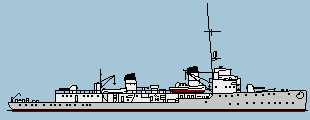
Design and service
The Flottenbegleiter F7 was used in the 2nd Geleitflotille after being commissioned. Used in the Baltic Sea after the outbreak of the war and sent to Helgoland on 6 September 1939 where it was operating as an escort vessel and used to lay mine fields. On 1 April 1940 it was attached to the 25th UFlottilla as a torpedo recovery vessel until June 1944 when it was used in the 7th MFlotilla. Taken over by the Soviets after the war, added to fleet lists on 5 November 1945. Added to the North Baltic Fleet on 15 February 1946 and renamed to Buran ten days later. On 2 December 1946, the ship was disarmed and reclassified as experimental ship and used until 24 April 1947.
On 7 May 1951 renamed to Dubna and reclassified as depot ship first in the North Baltic Fleet and from 24 December 1955 in the Baltic Fleet. Only nine months later, the ship was finally removed from the fleet lists and scrapped between 1957-1958.
At a glance
Dimensions, armament, machinery and performance.
Construction record