
Commissioned.
186,0 m (187,9 m)Overall length
15423 tMaximum displacement
28,3 knMaximum speed
1001-1150Complement
Design and service
The story of Admiral Scheer
The Treaty of Versailles sharply restricted German naval construction after World War I. Germany could retain six old pre-dreadnought battleships, six light cruisers, twelve destroyers and twelve torpedo boats. Article 190 permitted replacement of the battleships twenty years after commissioning, but limited each new armored ship to 10,000 tons.
The first replacement, Panzerschiff A, was ordered in 1928 and later entered service as Deutschland. Designers considered both a heavily armored coastal-defense ship and a faster cruiser with greater range but lighter protection. The latter concept was selected because it could threaten French merchant shipping while avoiding more powerful warships.
The design principle was to outrun any more heavily armed opponent and outgun any faster one. This concept was credible against the cruisers and older battleships then in service, although it became less effective after the appearance of fast battleships.
The Panzerschiffe introduced extensive welding and diesel propulsion to ships of this size. Welding reduced structural weight, while diesel engines provided the long range required for commerce warfare. Their declared displacement was 10,000 tons, but full-load displacement was about fifty percent greater. Deutschland, Admiral Scheer and Admiral Graf Spee shared the same basic design but differed visibly, particularly in their bridge structures.
All ships were used in the international sea patrols off the Spanish coast during the Spanish Civil War and had different fates in World War II. The Admiral Scheer made a six month combat mission in the South Atlantic and Indian Ocean which showed that the concept of a Diesel powered commerce raider did work, sinking over 100000 ts of Allied shipping. In 1940 the two remaining Panzerschiffe (Deutschland/Lützow and Admiral Scheer) were reclassified as Heavy Cruisers.
Admiral Scheer entered service in November 1934 and completed six non-intervention patrols off Spain, including the bombardment of Almería in 1937. Her commerce-raiding cruise from October 1940 to April 1941 took her from the Atlantic into the Indian Ocean. During the deployment she attacked convoy HX 84, sank the armed merchant cruiser Jervis Bay and accounted for or captured ships totaling 113,223 tons. In August 1942 she entered the Kara Sea during Operation Wunderland, sinking the Soviet icebreaker Alexander Sibiryakov and bombarding Port Dickson. Recommissioned for coastal support in late 1944, she fired on Soviet positions and carried wounded personnel and refugees westward before she capsized in Kiel after an air raid on 9 April 1945.
Operational history
Service timeline
Trials and training.
Visit to Danzig.
Battle training in the North Atlantic.
Fleet parade at Laboe.
Together with Deutschland voyage around Great Britain.
Visit to Stockholm.
First Spain operation.
Second Spain operation.
Third Spain operation.
Fourth Spain operation. After a bomb attack o the Panzerschiff Deutschland at Ibiza, Admiral Scheer and the torpedo boats Seeadler, Albatros, Luchs and Leopard bombard the harbor of Almeria.
Fifth Spain operation.
Fleet operations and training in the Baltic Sea.
Sixth Spain operation.
Fleet parade in Kiel because of the launch of the heavy cruiser Prinz Eugen.
Atlantic operation and trials.
Based in Wilhelmshaven, the Admiral Scheer shoots down a Blenheim IV bomber in the first British air raid on Wilhelmshaven.
In dock, command tower is replaced, reclassified as heavy cruiser.
Trials in the Baltic Sea.
Leaves Gotenhafen (Gdynia) for commerce war.
Passes Denmark Strait.
After the sinking of the refrigerator ship Mopan (5389 t) the Admiral Scheer attacks the convoy HX 84 at 52°45'N, 32°13'W. consisting of 37 merchants. While the auxiliary cruiser Jervis Bay defends the convoy and is sunk, the main body can escape. The total loss of HX 84 are: Jervis Bay (14164 t) Maidan (7908 t) Trewellard (5201 t) Kenbame Head (5225 t) Beaverford (10042 t) Fresno City (4955 t) Three other merchants with 27844 t are damaged.
Refueled by the tanker Eurofeld.
Resupplied by supply ship Nordmark.
Sinks Port Horbard (7448 t) SE of the Bermudas.
Sinks Tribesman (6242 t) west of Bathurst.
Resupplied by supply ship Nordmark.
Captures British refrigerator ship Duquesa (8651) with 14.5 million eggs and 3000 t of meat on board. The Duquesa was used to resupply the auxiliary cruisers Pinguin and Thor and the supply ship Nordmark. The Duquesa is sunk by the Pinguin in February 1941.
Admiral Scheer meets with auxiliary cruisers Thor and Pinguin, resupply ship Nordmark, tanker Eurofeld and the captured Duquesa at point "Andalusien" 15°S 18°W.
Admiral Scheer unsuccessfully tries to attack the Troop Convoy WS5A which has been attacked by CA Admiral Hipper on December 24th
Norwegian tanker Sandefjord (8038 t) is captured and send to Bordeaux.
Sinks Dutch steamer Barneveld (5597 t) and British freighter Stanpark (5103 t)
Another meeting at "Andalusien" between Admiral Scheer, Thor and Nordmark.
Passes Cape of Good Hope.
Meets with auxiliary cruiser Atlantis, the war prizes Speybank and Letty Brövi and the German freighter Tannenfels at 13°S, 64°E.
Sinks the Greek freighter Gregorios (2546 t) at the northern end of the Mozambique Channel. The British tanker British Advocate (6994 t) is captured.
Sinks the Canadian Cruiser (7178 t). Admiral Scheer is ordered home.
Sinks Indonesian steamer Rantaupandjang (2542 t). A few hours later, the Admiral Scheer is sighted by a plane of the British CL Glasgow at 8°30'S, 51°35'E. The Admiral Scheer is unsuccessfully hunted by the CV Hermes, CA Canberra, Australia and Shorpshire and the CLs Glasgow, Cape Town and Emerald.
Passes Cape of Good Hope.
Another meeting at "Andalusien" between Admiral Scheer, Nordmark and the auxiliary cruisers Pinguin and Kormoran.
Admiral Scheer meets German freighters Portland and Alsterufer.
Passes Denmark Strait.
Reached Bergen.
Arrived in Kiel. On her voyage, the Admiral Scheer has sunk 14 ships with 84027 t, captured 2 with 15032 t and destroyed an auxiliary cruiser with 14164 t. Total 113223 t.
Repairs in Kiel.
Part of the Baltic Fleet.
Transferred to Drontheim.
Moved to Bow Bay near Narvik.
Together with the Lützow and six DDs, the Admiral Scheer forms a squadron to attack the arctic convoy PQ-17. The squadron is called back after the convoy has broken up.
Friedrich Eckold, Erich Steinbrinck and Richard Beitzen escort the heavy cruiser Admiral Scheer to the Bear Islands.
Operation "Wunderland": With 3 U-boats the Admiral Scheer sails to the Cara Sea. Russian ice-breaker Alexander Siriyakov is sunk on the 25th, Port Dickson bombarded on the 27th, damaging another ice-breaker and a tanker.
Friedrich Eckold, Erich Steinbrinck and Richard Beitzen escort the heavy cruiser Admiral Scheer from Bear Island to Norway.
The destroyers Richard Beizen, Z23, Z28, Z29 and Z30 proceed to a mine laying operation at Nowaja Semlja. They are covered by the heavy cruiser Admiral Scheer.
Richard Beitzen, Friedrich Eckoldt and Z29 escort the heavy cruiser Admiral Scheer from the Altafjord to Narvik.
Richard Beitzen, Friedrich Eckoldt, Z23, Z28 and Z29 escort the battleship Tirpitz and the heavy cruiser Admiral Scheer from Narvik to Trondheim.
Z23, Z28 and Z29 escort the heavy cruiser Admiral Scheer from Trondheim back to Germany.
Returns to Kiel.
Repairs in Wilhelmshaven, afterwards, the ship is used as a training ship based in Gotenhafen (Gdynia) and is decommissioned.
Put into service again.
Support of the German Army.
Bombardments at Diefenov and Swinemünde. As the barrels are worn out, the Admiral Scheer is ordered to Kiel for repairs. Takes over 200 wounded and 800 refugees at Pilau.
After several bomb hits the Admiral Scheer capsized.
The wreck, buried under rubble, is broken up.
At a glance
Technical profile
Dimensions, armament, protection and performance.
Dimensions
- Size (Max)
- 15423 t
- Length (Total)
- 186,0 m (187,9 m)
- Length (Waterline)
- 181,7 m
- Beam
- 21,34 m
- Draft
- 7,25 m
- Crew
- 1001-1150
Armament
- 28 cm L/52 C/28
- 6
- 15 cm L/55 C28
- 8
- 3,7 cm L/83
- 8
- 2 cm MG L/64
- 8 (28)
- 53,3 cm Torpedoes
- 8
Aircraft
- Arado Ar 196
- 2
Protection
- Deck
- 45 mm (max)
- Belt
- 80mm (max)
- Command Tower
- 150 mm
- Turrets
- 140 mm (max)
Machinery
- Shafts
- 2
- Engines
- 8
- Type
- MAN 9-cyl. diesel
Performance
- Total Performance
- 52050 shp
- Speed
- 28,3 kn
- Range
- 17460 miles at 15 kn
The archive
Photographs
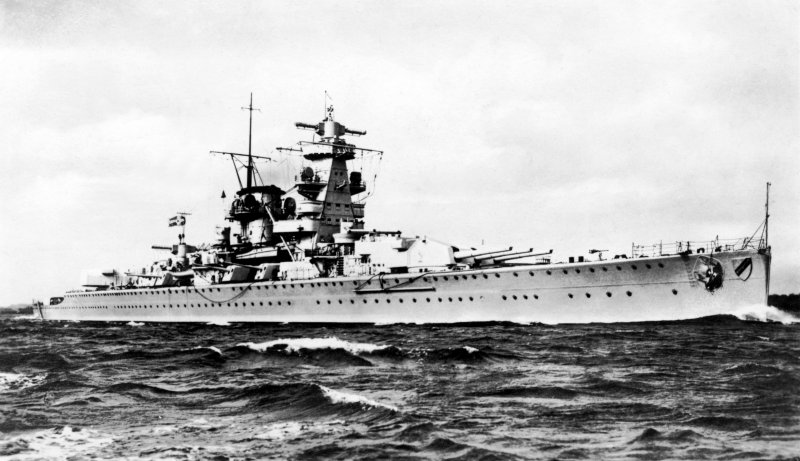
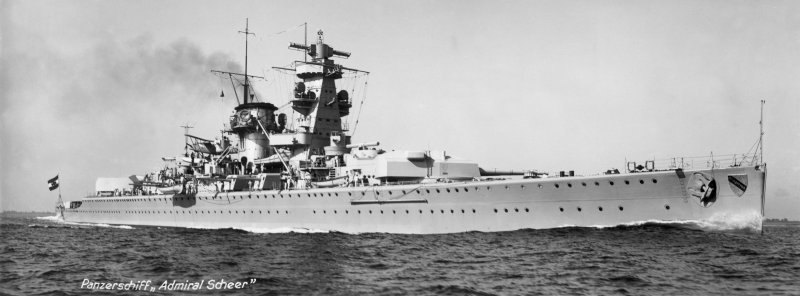
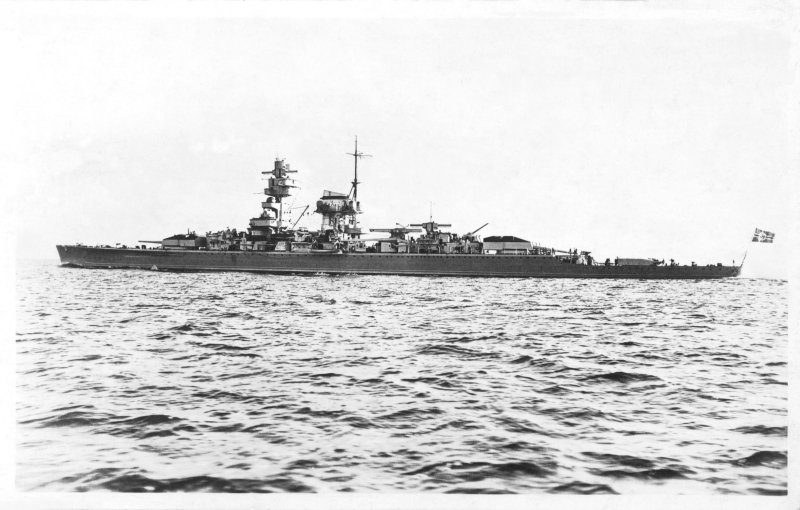
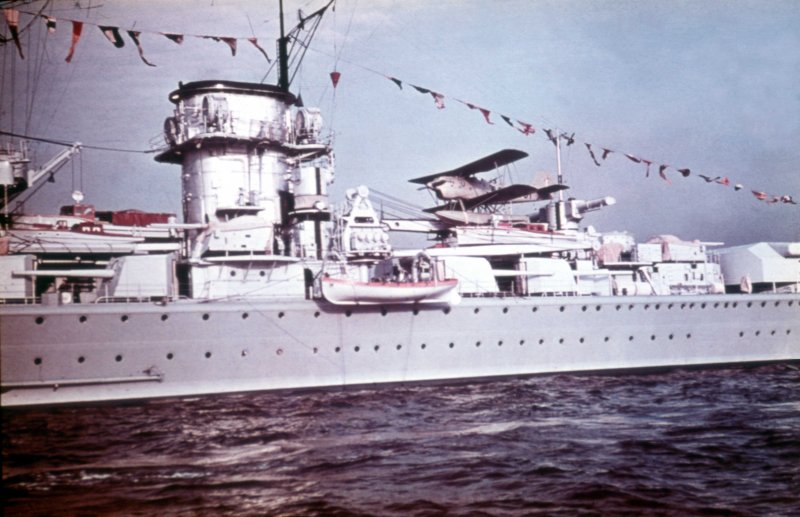
Original postcard and photographic material from the private collection.
The archive
Models
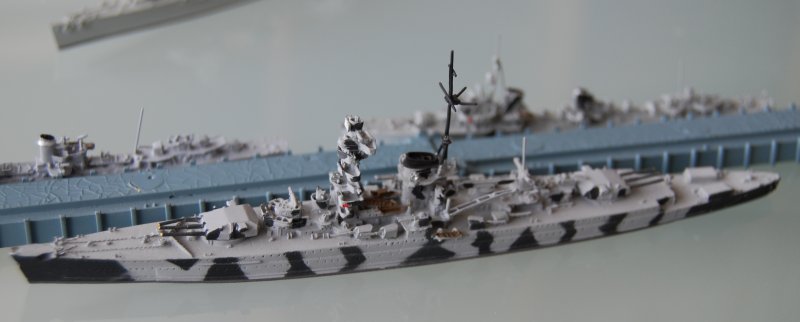
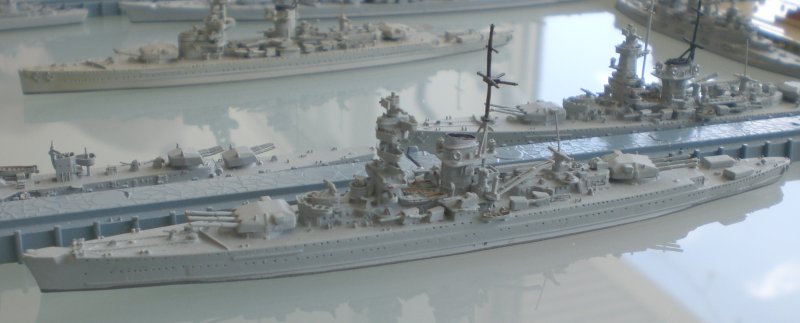
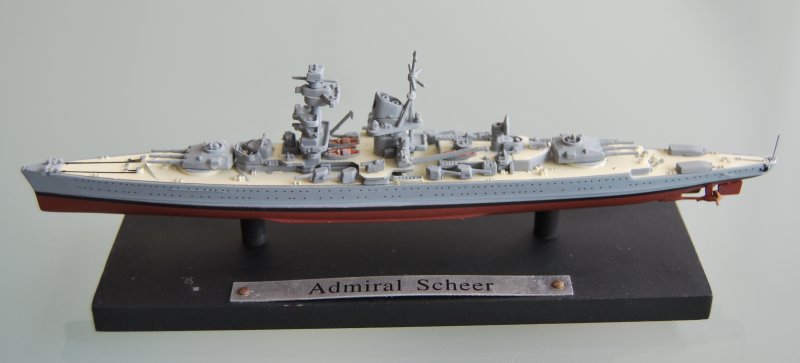
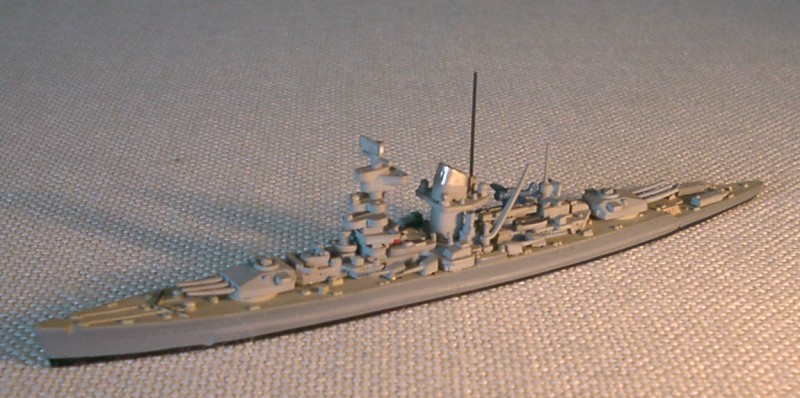
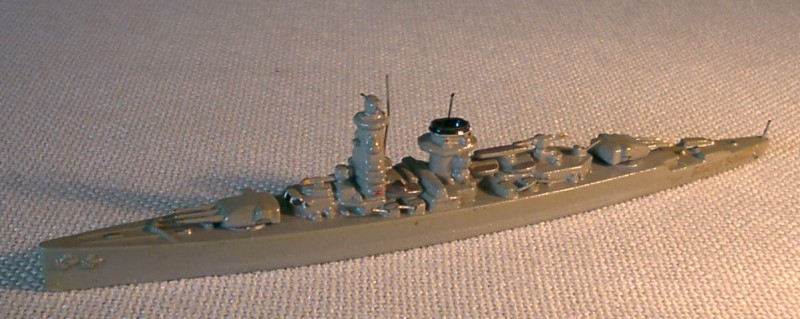
Ship models in 1/1250 scale.
Construction record
Admiral Scheer
- Laid down
- Reichsmarinewerft Wilhelmshaven, 25.06.1931
- Launched
- 01.04.1933
- Commissioned
- 12.11.1934
- Fate
- sunk by bombs 9-10.04.1945 (Kiel)
- Cost
- 90 Mio Reichsmark