A cleaner and more powerful design
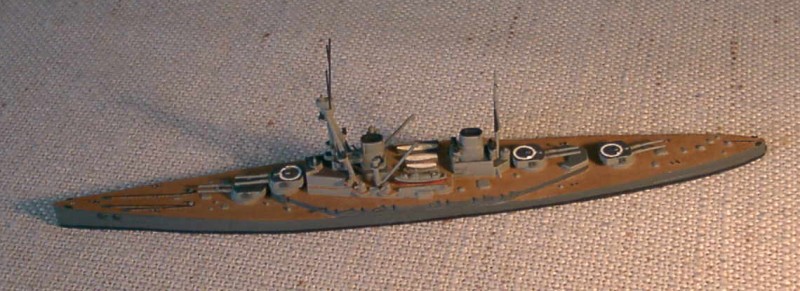
Eight 30.5 cm guns in centerline turrets gave the class stronger firing arcs and a silhouette that anticipated later fast capital ships.

Design and service
The development of German battlecruisers in the Imperial Navy can be easily traced back to the last armored cruisers, the Blücher. All battlecruiser evolved from this design, improving from class to class up to the Seydlitz, all showing a very similar outer appearance. The following three battlecruisers of the Derfflinger class were a major change in which marked the step to modern battlecruisers. Although the previous ships proved to be very good protected, their diagonal mounted midship turrets were a clear sign of their origins at the beginning of the century.
The Derfflinger class had all gun turrets mounted in the center line and were the only German battlecruisers with 30,5 cm guns, but the higher weight caused the reduction of only 8 guns. The armor scheme was quite similar to those of the previous battlecruisers and made them good protected ships. A modified bow design should improve the seagoing capabilities of this battlecruisers, but although there was an improvement, they were still very "wet" ships.
All ships were commissioned after the outbreak of World War I Derfflinger and Lützow took part in the Battle of Jutland, and were badly damaged when they were hit over twenty times each. Since Lützow was damaged too badly, the ship had to be sunk after the battle, it was the biggest ship lost on by the Imperial Navy. Hindenburg was only commissioned in 1917 and did not see much action in the war. The two surviving ships shared the fate of most other Imperial Navy ships - they ended at Scapa Flow.
Derfflinger's wartime career made her the most battle-tested member of the class. She fought at Dogger Bank, bombarded the British coast and played a central role at Jutland, where her gunfire contributed to the destruction of Queen Mary and Invincible. Despite 21 heavy and medium-caliber hits, about 3,000 tons of water entering the hull and 157 crew casualties, she returned to Germany for repairs. She was interned and scuttled at Scapa Flow in 1919, raised in 1939 and dismantled after the Second World War.
Operational history
First unsuccessful attempt to launch the ship, but it got stuck on the shipyard.
Successful launch.
Although not commissioned yet, the Derfflinger is part of the naval defenses of Kiel.
Part of the 1st Reconnaissance Group (1. Aufklärungsgeschwader) after commissioning.
First operational action, NW of Helgoland.
Operation J2: Coastal bombardment of Hartlepool.
Battle at the Doggerbank against British battlecruisers, Derfflinger is hit once, but damages the British BC Lion.
Repairs.
Participation in several fleet actions in the North Sea.
Mayor turbine breakdown.
Derfflinger is used to test alternative courses to enter the Baltic Sea.
Operations at the Hoofoten.
Coastal bombardment of Yarmouth and Lowestoft.
Battle of Jutland: Derfflinger sinks British battlecruisers Queen Mary and Invincible. The ship is badly damaged (17 heavy and 4 medium hits) and returns to Wilhelmshaven with 3000 t water in the ship and 157 crew casualties.
Repairs at Howaldtswerke, Kiel.
Unsuccessful raid in the Northern North Sea.
Interned at Scapa Flow.
Scuttled by own crew.
Wreck raised.
Broken down at Rosyth.
At a glance
Dimensions, armament, protection and performance.
The archive
Ship models in 1/1250 scale.
Construction record