More guns and greater endurance
Ten 28 cm guns and improved protection developed the first German battlecruiser concept into ships suited for demanding fleet and overseas service.

Design and service
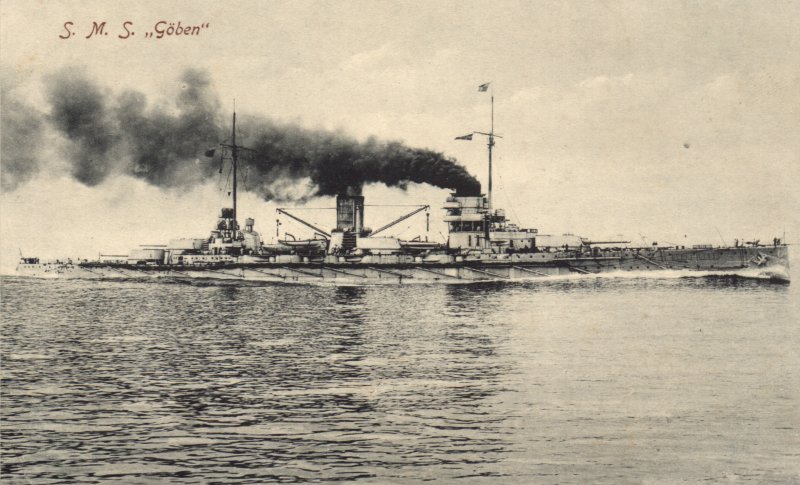
The two battlecruisers of the Moltke class were the successors of Germanys first battlecruiser, the Von der Tann. While their predecessor was still in development and construction, plans for a enlarged version of this ship were made. With a enlargement of about 3500 ts, a fifth gun turret, longer bow and enhanced armor were added to the two battlecruisers, giving them a much better protection than their British counterparts. While British battlecruisers of this time already had 30,5 cm guns, the Moltke and Goeben still had the 28cm guns of their predecessor (although a more modern version of this guns was used. Caused by the narrow stern, it was impossible to install two parallel rudders, therefor the rudder had to be enlarged and supported by an second auxiliary rudder mounted in front of it. As both ships received a lot of battle damage, they proved to be very good protected ships, their main disadvantage was that caused by the low bow height their seagoing capabilities was not so good at all.
Goebens life was quite unique - as part of the Mediterranean Division, the ship was sold to Turkey in 1916, but still operated with the German crew on board. During the operations against the Russian fleet in the Black Sea, the ship was called "Dyadya" - The Uncle" by the Russians. At the end of World War I, it was completely taken over by Turkey and in Turkish services until 1954. Since negotiations failed to return the ship to Germany, it was scrapped in 1974.
Operational history
Tests and trials.
Goeben is commissioned.
Participation in autumn fleet manouvers.
Part of the Mediterranean Division.
Operations in the eastern Mediterranean Sea.
Repairs in Pola.
Visit to Italy and the Adriatic Sea.
Repairs in Pola.
Coastal bombardment of Philippeville while on the way to the Dardanelles.
Battle with British CL Glouchester.
Arrived at Constantinopel, ship sold to Turkey but still operated by the German crew.
Renamed to Jawus Sultan Selim.
Coastal bombardment of Sevastopol, on the return to Turkey, battle with three Russian destroyers and the Minelayer Prut. The Prut was scuttled by its own crew and the flagship of the 4th destroyer flotilla Leitenant Pushchin was heavily damaged by Goebens gunfire.
Bombardment of the Crimea peninsula (Battle off Sarych Cape), battle with parts of the Russian Black Sea fleet including the BB Svjatoj-Evstafij and four other battleships. Jawus Sultan Selim is hit once, the Russian BB is damaged by three hits.
Hit by two mines while entering the Bosporus
Raid into the Black Sea.
Raid into the Black Sea.
Raid into the Black Sea.
Repairs.
Raid in the Black Sea, two Russian merchant ship sunk.
Raid in the Black Sea.
Goeben engages the Russian Black Sea Fleet consisting of the battleships Svjatoj-Evstafij and Ioann Zlatoust while they attack coastal forts in the Bosporus. Jawus Sultan Selim is hit three times.
Battle with Russian battleship Imperatrica Ekaterina II. The battle lasted for 11 minutes.
Bombardment of Tuapse and Sochi. Exiting the Bosporus, the battlecruiser is surprised by the Russian battleships Imperatrisa Ekaterina Velikaya, Paimat Merkuria, two submarines and two additional battleships further away. Due to tactical mistakes of the Russian commander, the Jawus Sultan Selim escaped unharmed.
Operation against British troop transports in the Mediterranean. One mine early in the operation. Jawus Sultan Selim sinks the British monitors Raglan and M28 at Imbros. Operation is canceled after two additional mine hits. On its way back to Turkey, the ship is attacked by British aircraft, hit twice and runs aground.
Ship is afloat again.
Jawus Sultan Selim enters Sevastopol harbor. First possibility to dock the ship in four years.
Repairs at Sevastopol.
Sent to Novorossijsk.
Taken over by Turkish crew.
Not operational.
Modernized by French shipbuilders, recommissioned as Jawus Selim.
Renamed to Yavuz.
Mainmast is removed, 28cm gun mountings are modernized.
Removed from Turkish Navy lists.
Sales negotiations with Germany fail.
Ship is broken down.
At a glance
Dimensions, armament, protection and performance.
The archive
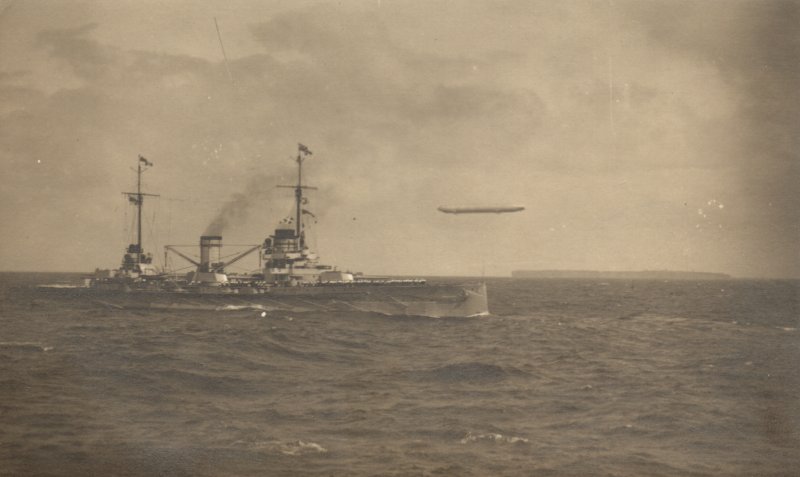
Original postcard and photographic material from the private collection.
Construction record