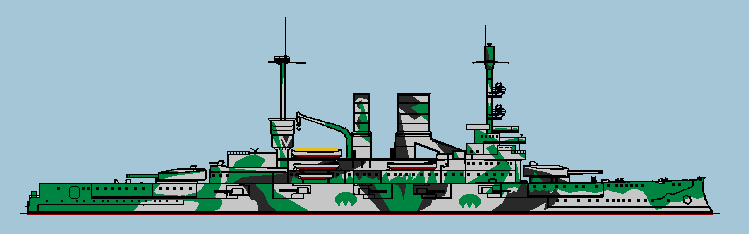
Participated in Battle of Jutland in 2nd Squadron.
127,6 mOverall length
14218 tMaximum displacement
19,1 knMaximum speed
742 - 802Complement
Design and service
The story of Schleswig-Holstein
After World War I Germany was only allowed to keep six old pre Dreadnought battleships (plus two on reserve). These were the ships of the Braunschweig and Deutschlandclass. Build between 1904 and 1905, the Braunschweig class was already obsolete during World War I and were decommissioned in 1917, but the lack of available ships forced those veterans of the Battle of Jutland into service again.
They were not able to fight any modern warship of their time and could only be used as coast defense or training ships. In this role, they made intensive voyages to Africa, Middle- and South America between 1926 and 1939. Most of those ships didn't see action in World War II anymore, since they were replaced by modern units, only the Schleswig Holstein and Schlesien did.
The Braunschweig was broken down in 1931, the Elsass in 1936, the Hessen was replaced by the Admiral Scheer and used as a target ship, the Lothringen was only used as a naval reserve, the Preussen was broken down in 1931 while some parts were used for torpedo and mine tests.
Schleswig-Holstein served at the Battle of Jutland and later became one of the Reichsmarine's principal training ships. Her bombardment of Westerplatte on 1 September 1939 marked the opening of hostilities between Germany and Poland. In April 1940 she carried troops to Nyborg during Operation Weserübung, after which she was used mainly as an accommodation and training ship before conversion to an anti-aircraft ship in 1944. Bombed at Gotenhafen on 18 December 1944, she settled on the harbor bottom and was scuttled in March 1945. Soviet forces later raised the wreck and eventually used it as a Soviet target ship off Osmussaar.
Operational history
Service timeline
At 4.45 AM the Schleswig Holstein opens World War II by firing on the western flats of the Westerplatte peninsula
"Operation Weserübung": Together with MTBs and fishing craft, the Schleswig Holstein transports army soldiers from Eckernförde Bight.
Troop landings in Nyborg.
Used as a dormitory ship at Gotenhafen (Gdynia) or as a training ship. The ship sails about 6000 nautical miles in this period.
Used as Flak Ship, equipped with more AA guns.
After brought in a battle ready state, the Schleswig Holstein was hit by three bombs during an air raid on Gotenhafen (Gdynia). The ship sink on its keel.
Large fire on board.
Removed from fleet list, most of the crew is killed in defense of Marienburg.
The wreck is blown up.
The wreck us raised by the ASS of the 4th Soviet fleet and towed to Tallin.
Added to Soviet fleet lists, some sources say that it was renamed to Borodino. The ship is used as a dormitory ship for a short time.
Scuttled in shallow water near Odsmussar island and used as an airforce target ship. The remains existed until the 1970s, the wreck can now be found in shallow water in a depth of 10 meters.
At a glance
Technical profile
Dimensions, armament, protection and performance.
Dimensions
- Size (Max)
- 14218 t
- Length (Total)
- 127,6 m
- Length (Waterline)
- 125,9 m
- Beam
- 22,2 m
- Draft
- 8,21 m
- Crew
- 742 - 802
Armament
- 28 cm L/20
- 4
- 15 cm L/45
- 14 (12 since 1931, 10 since 1935, 0 since 1939)
- 8.8 cm L/45
- 20 (4 since 1919; 2 since 1927)
- 3,7 cm L/83 C/30
- 4 (since 1936)
- 2 cm MG L/83
- 4 - 22
Protection
- Belt
- 240 mm (max)
- Deck
- 40 mm
- Command Tower
- 300 mm
- Turrets
- 280 mm (max)
Machinery
- Shafts
- 3
- Engines
- 3
- Type
- 3-cyl expansion engines
Performance
- Total Performance
- 19330 shp
- Speed
- 19,1 kn
- Range
- 4800 sm at 10 kn
The archive
Photographs
Original postcard and photographic material from the private collection.
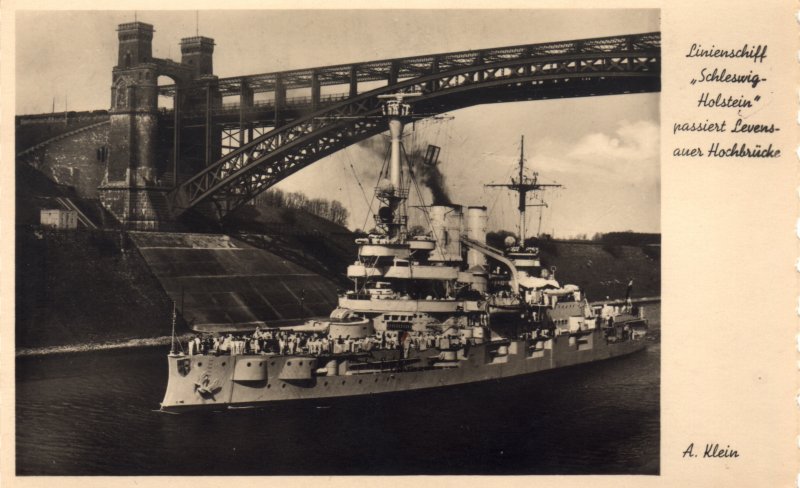
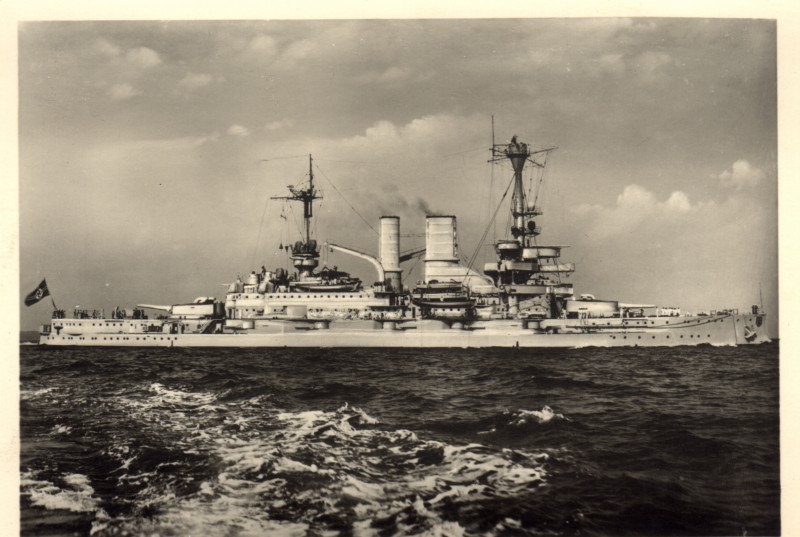
The archive
Models
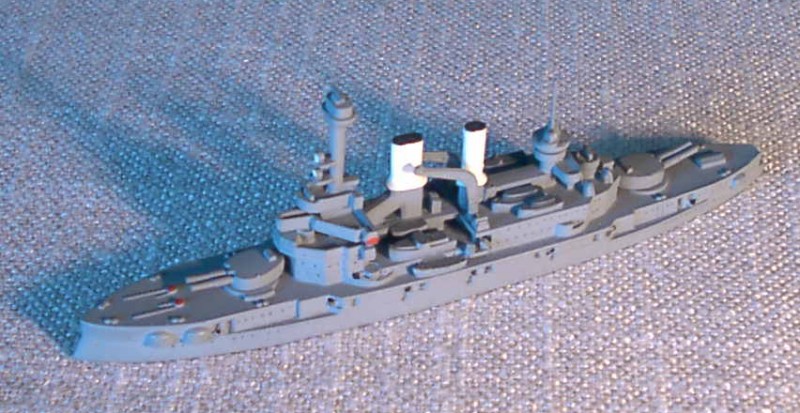
Ship models in 1/1250 scale.
Construction record
Schleswig-Holstein
- Laid down
- Germaniawerft Kiel, 1905
- Launched
- 07.12.1906
- Commissioned
- 06.07.1908
- Fate
- scrapped after 1946
- Cost
- 25 Mio Reichsmark