Germany's first purpose-built armored cruiser
Heavy protection and a mixed-caliber battery created a powerful flagship for the expanding East Asia Squadron.
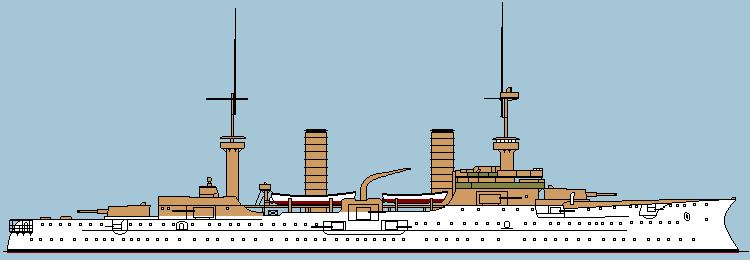
Design and service
Fürst Bismarck brought battleship-like presence to distant waters and gave the East Asia Squadron a powerful command platform.
The full story
With the Fürst Bismarck, a new step in armored cruiser design (official designation was "Großer Kreuzer") was made. Better protected than its predecessors and much heavier armed, it was planned as a prototype for a new generation of armored cruisers capable for reconnaissance operations and overseas duties. Unlike all cruisers classes before only a single ships of this class was built, it was meant as a operational testbed to find out problems and capabilities of this new design and to used this information to build other, more advanced ships.
The ship had excellent seagoing capabilities and was very maneuverable, but it tended for vibrations at higher speeds.
Fürst Bismarck almost all of its operational career in the East-Asian Squadron where it was stationed for nine years. Like all other armored cruisers, it was reactivated at the outbreak of World War I, but soon put into auxiliary services only. It was scrapped after the war.
Operational history
First trials before being commissioned.
Fürst Bismarck is commissioned.
Sent to China after shortened tests and trials
Arrives in Tsingtau.
Operations as part of the international forces against China.
Repairs in Nagasaki.
Operations off the Chinese coast.
Repairs in Nagasaki.
Fürst Bismarck becomes flagships of the East-Asian Cruiser Squadron
Operations off the Chinese coast, Japan and Indonesia.
Because of the technical conditions of the ship, Fürst Bismarck is ordered back to Germany after 9 years in South East Asia.
The ship arrives in Kiel.
Decommissioned.
Refits at Kaiserliche Werft Kiel shipyard and modification to torpedo test ship.
Recommissioned, but bad general conditions did not allow to use the ship even for coastal defenses.
Assigned to torpedo trial command as target ship, but the ship was not usable for this role anymore.
Used as engine training ship in Kiel.
For a short time, Fürst Bismarck sailed again as training ship for commanders of transport U-Boats and Naval Airships.
Decommissioned.
Used as a floating naval office for a short time.
Stricken from fleet list and scrapped in Audorf near Rendsburg soon after that.
At a glance
Dimensions, armament, protection and performance.
The archive
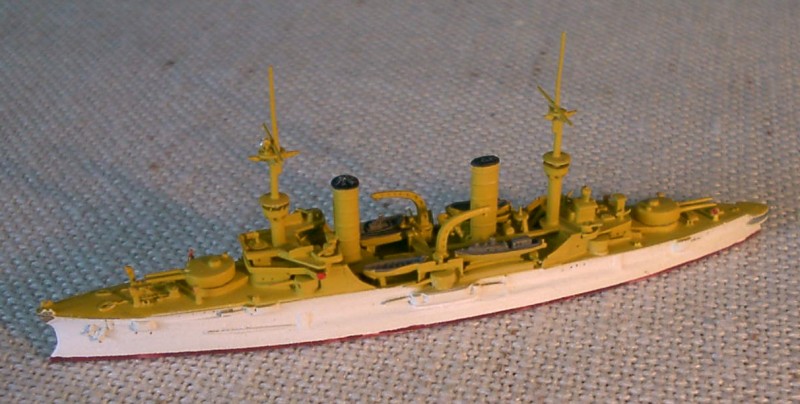
Ship models in 1/1250 scale.
Construction record