A class shaped by overseas ambitions
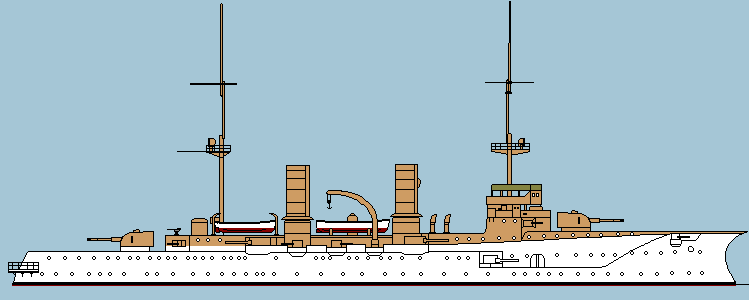
Five protected cruisers combined a substantial gun battery with accommodation and endurance suited to foreign stations and training duties.
Design and service
Victoria Louise embodied Germany's late-nineteenth-century overseas ambitions, then found a lasting role preparing officers for a rapidly expanding navy.
The full story
The five protected cruisers of the Victoria Louise class, officially designated "Große Kreuzer," were intended for overseas service and fleet reconnaissance. They marked an early stage in the development that eventually produced the German battlecruisers, but several shortcomings limited their effectiveness.
Their limited range restricted overseas employment, while weak side protection made them vulnerable in combat. Hot and cramped accommodation reduced crew comfort, and their modest speed limited their usefulness with the fleet.
Despite these limitations, the ships handled well at sea, although their high hulls and superstructures made them sensitive to strong winds.
All five ships were reconstructed between 1905 and 1910. Their boilers were replaced, one funnel was removed and their operational range was increased. They subsequently served as training ships and were reactivated at the outbreak of World War I. Their limited combat value soon confined them to secondary or stationary duties. All five were scrapped in the early 1920s.
Operational history
First trials.
Repairs and refits.
Additional tests and trials.
Sent to Britain to participate in the fleet parade at the burial ceremony for Queen Victoria.
Attached to the 1st Squadron.
Used in the Artillery Inspection.
Operations off the Chinese coast.
Flagship of the 1st Squadron.
Attached to the Reconnaissance Forces.
Visit to Spain.
Decommissioned.
Reconstruction at Kaiserliche Werft Wilhelmshaven.
Reclassified as training ship.
Training voyage to Spain, the Mediterranean. During this voyage, several meteorological experiments are done on the Victoria Louise.
Training voyage to the USA and the Westindies. During this voyage, the Victoria Loise take part in the fleet parade at the Hudson-Fulton ceremony in September 1910.
Training voyage to the Mediterranean.
Training voyage to Norway, North America and the West Indies.
Training voyage to the Mediterranean.
Training operations in the Baltic Sea and Norway.
Reassigned to fleet services for coastal defense.
Decommissioned because of bad general condition, used as a floating barrack and mine depot.
Stricken from fleet list, sold to a Berlin construction company.
Reconstruction to civil merchant ship and renamed to Flora Sommerfeld in Danzig.
Scrapped down in Danzig.
At a glance
Dimensions, armament, protection and performance.
The archive
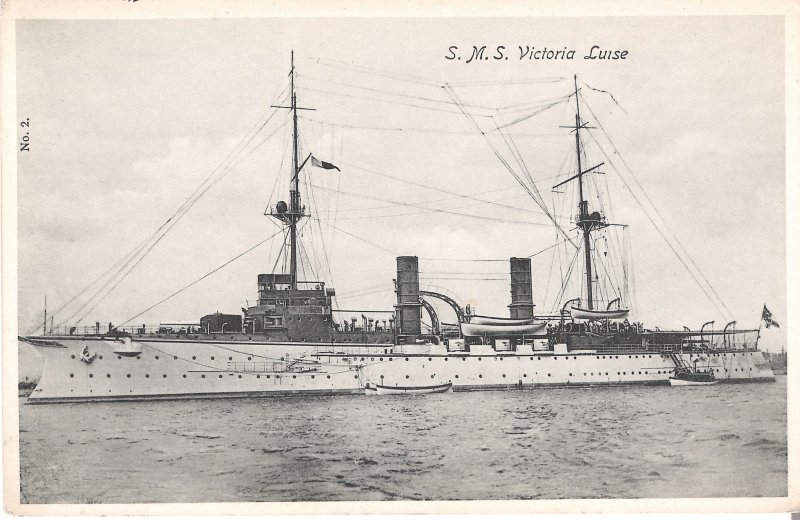
Original postcard and photographic material from the private collection.
Construction record