A class shaped by overseas ambitions
Five protected cruisers combined a substantial gun battery with accommodation and endurance suited to foreign stations and training duties.
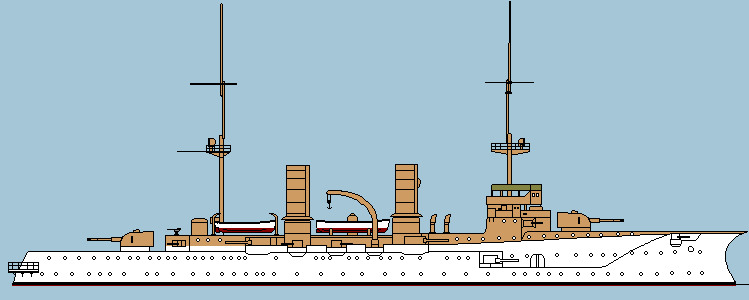
Design and service
Hansa joined the Imperial Navy's most visible foreign deployment before transitioning into the less dramatic but essential work of training.
The full story
The five protected cruisers of the Victoria Louise class, officially designated "Große Kreuzer," were intended for overseas service and fleet reconnaissance. They marked an early stage in the development that eventually produced the German battlecruisers, but several shortcomings limited their effectiveness.
Their limited range restricted overseas employment, while weak side protection made them vulnerable in combat. Hot and cramped accommodation reduced crew comfort, and their modest speed limited their usefulness with the fleet.
Despite these limitations, the ships handled well at sea, although their high hulls and superstructures made them sensitive to strong winds.
All five ships were reconstructed between 1905 and 1910. Their boilers were replaced, one funnel was removed and their operational range was increased. They subsequently served as training ships and were reactivated at the outbreak of World War I. Their limited combat value soon confined them to secondary or stationary duties. All five were scrapped in the early 1920s.
Operational history
Hansa is transferred to Kiel for final construction.
Commissioned.
During trials, the ship runs aground in heavy fog. With only minor damages, the ship is returned to Kiel by the coast defence ships Aegir and Odin.
Send to South-East Asia.
Visit to Haifa.
Arrival in Colombo. Due to several engine breakdowns and exhaustion of the engine crew, the ship must do a stop.
Arrival in Singapore.
After a boiler explosion, the ship has to return to Singapore.
Hansa leaves Singapore heading for Tsingtau.
Arrival in Tsingtau.
Because of the Boxer uprising, Hansa sails to the Taku river.
Landing troops from the Hansa join the forces to attack the Taku fort.
Operations against coastal forts.
Visit to Nagasaki.
Repairs in Hong Kong.
Sent to Australia to represent Germany during celebrations of the founding of the Commonwealth of Australia.
Arrival in Melbourne.
Visit to Sydney.
Return to Tsingtau.
Visit to Nanking.
Participation in the fleet parade at Kobe.
Repairs in Uraga.
During the Russian-Japanese war, the Hansa transports Germans from Seoul, Port Arthur and Dalny to Tsingtau.
Hansa tows the NDL steamer Roon to Nagasaki, which has run aground at Kotushima.
Ordered back to Germany.
Decommissioned in Danzig.
Reconstruction, one funnel removed, armament modified.
Recommissioned as cadet training ship.
Training voyage to the Mediterranean.
Training voyage to the Caribbean Sea and east coast of the USA.
Training voyage to the USA.
Visit to St. Petersburg.
Training voyage to the Caribbean Sea and east coast of the USA.
Training voyage to the Mediterranean.
Attached to the 5th Reconnaissance group.
Patrol duties in the Baltic Sea.
Repairs in Danzig.
Decommissioned in Kiel because of lack of personnel and only small military value of the ship.
Used as floating barrack for torpedo boat crews.
Stricken from list of warships.
Scrapped in Audorf.
At a glance
Dimensions, armament, protection and performance.
Construction record