A leaner fleet reconnaissance design
Reduced armor and armament traded weight for speed, establishing the pattern for German armored cruisers intended to scout with the battle fleet.
Design and service
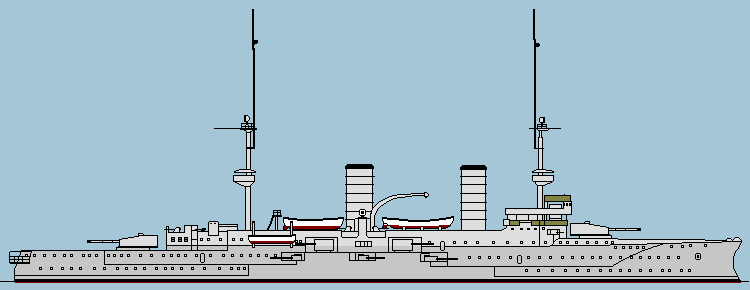
Prinz Heinrich accepted lighter armament than her predecessor to gain the speed and characteristics needed for reconnaissance ahead of the fleet.
The full story
Planning for the Prinz Heinrich started immediately after the planning of its predecessor, the Fürst Bismarck, was completed. Although being very close to the previous design, the slightly smaller Prinz Heinrich could be summarized as following: Half of the armor and half of the main guns - the result was a ship which battle capabilities had to be questioned. Another effect was that the reduction of guns and armor also caused a reduction of construction costs. The only improvement to the Fürst Bismarck was a small speed improvement due to more powerful engines.
Like most other German armored cruisers, the Prinz Heinrich was reactivated at the outbreak of World War I but did not see much combat action. Used as a auxiliary ship in the second half of the war it was scrapped in 1920.
Operational history
Part of the Reconnaissance Group of the 1st Squadron after being commissioned.
Flagship of the reconnaissance forces.
Decommissioned.
Recommissioned as artillery training ship.
Decommissioned.
Recommissioned at the outbreak of the war.
As part of the 4th Reconnaissance Group, Prinz Heinrich is used as a defense ship in the Baltic Sea entrance and for patrols in the Jade estuary
Attached to the Baltic Sea fleet.
Several operations in the Baltic Sea like mine laying, the attack on Libau and operations at the Baltic Islands.
Decommissioned caused by the lack of personnel. Used as barrack ship.
Stricken from fleet list, in the following time, Prinz Heinrich is scrapped in Audorf near Rendsburg.
At a glance
Dimensions, armament, protection and performance.
The archive
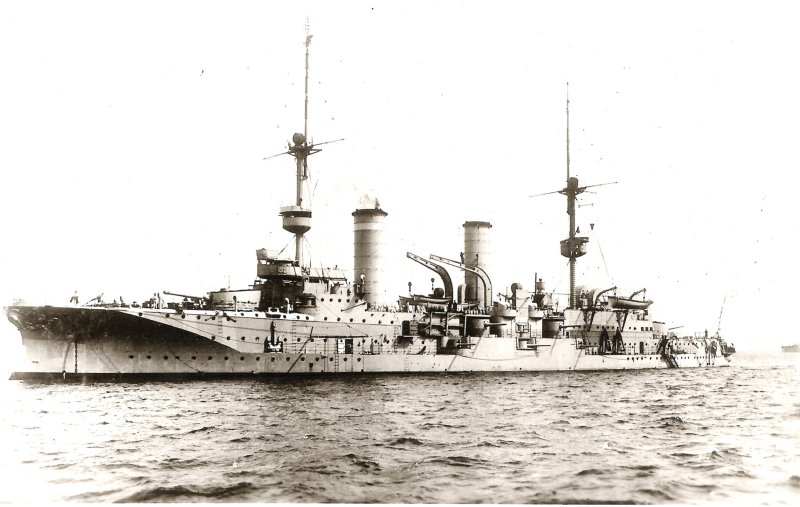
Original postcard and photographic material from the private collection.
Construction record