The mature pre-turbine cruiser
Refined protection, four funnels and reliable machinery produced capable scouts, though foreign battlecruiser development soon made them obsolete.
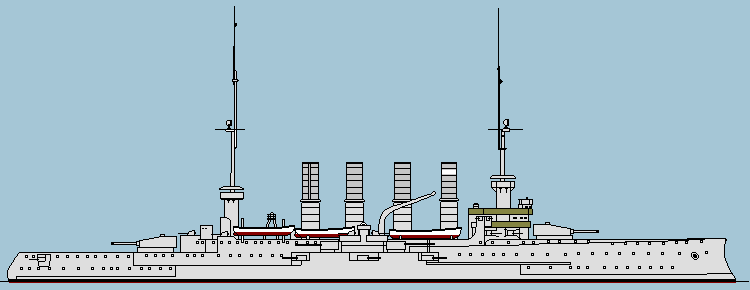
Design and service
Roon represented a polished conventional armored-cruiser design, but turbines and battlecruisers transformed naval warfare soon after completion.
The full story
Although looking different to their predecessors, the two armored cruisers of the Roon class were very similar to the Prinz Adalbert class. With the same armament, same armor protection scheme their only improvement was speed - to increase their top speed, a larger engine system and a fourth funnel had to be added.
Unlike other armored cruisers, they were used for normal fleet operations during World War I. Roon took part in some Baltic Sea operations, from 1916 it was used as a floating barrack in Kiel. In 1918 it was considered to convert the ship into a seaplane carrier, but this was canceled after the end of the war. In 1921, the ship was scrapped in Kiel.
Operational history
After training and trials the ship is attached to the reconnaissance forces.
Decommissioned.
At the outbreak of the war, the armored cruiser is attached to the 3rd Reconnaissance Squadron.
Operations in the Eastern Baltic Sea to assist the grounded CL Magdeburg.
Used to protect the Baltic Sea entrance.
Roon took part in several Operations in the Baltic Sea: The attack on Libau, several mine operations and the invasion of the baltic islands.
Put out of active service due to of bad material conditions. The ship is used as a torpedo test ship and training ship for cadets.
Conversion into seaplane carrier is stopped at the end of the war.
Stricken from fleet lists.
Broken down in Kiel.
At a glance
Dimensions, armament, protection and performance.
The archive
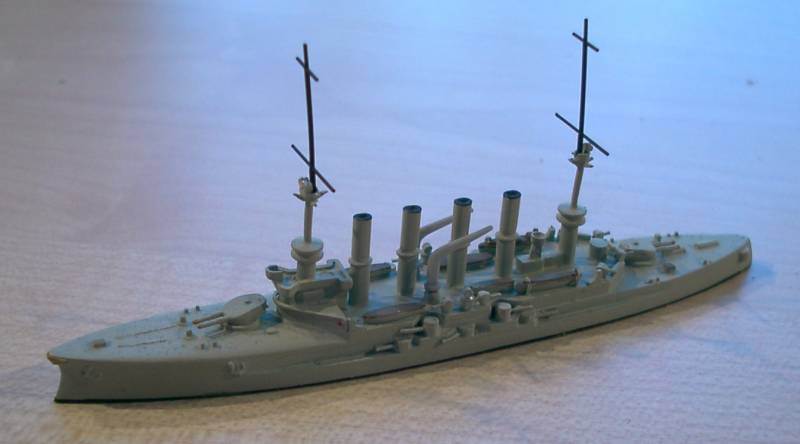
Ship models in 1/1250 scale.
Construction record