The mature pre-turbine cruiser
Refined protection, four funnels and reliable machinery produced capable scouts, though foreign battlecruiser development soon made them obsolete.
Design and service
Yorck served routinely with the fleet before the confusion and hazards of early wartime operations produced a sudden catastrophe.
The full story
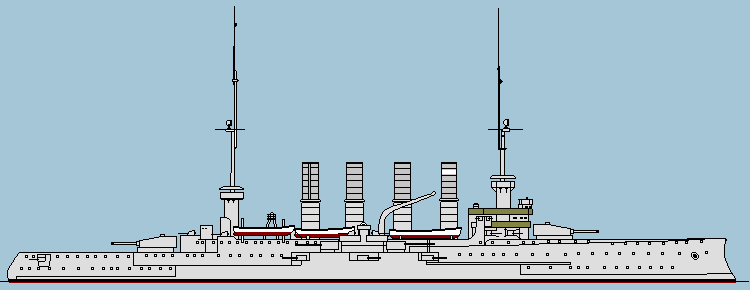
Although looking different to their predecessors, the two armored cruisers of the Roon class were very similar to the Prinz Adalbert class. With the same armament, same armor protection scheme their only improvement was speed - to increase their top speed, a larger engine system and a fourth funnel had to be added.
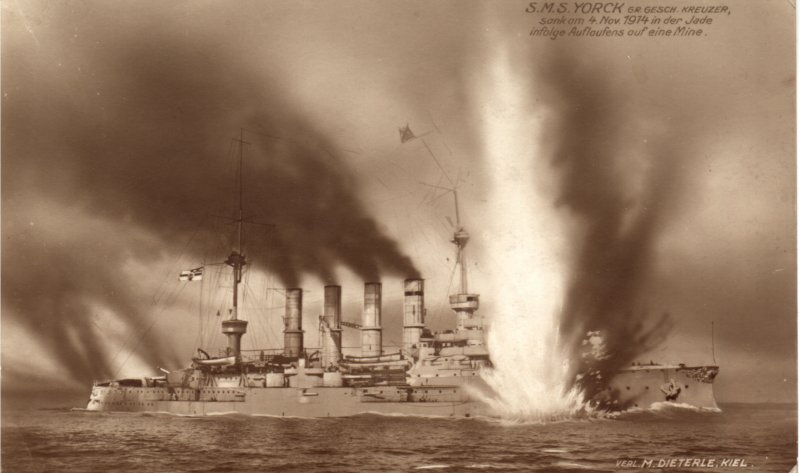
Unlike other armored cruisers, they were used for normal fleet operations during World War I. York was lost early in the war. On 04.11.1914 it run into a own mine field and sunk with a great loss of life (336 crew members). The wreck was partly broken down in 1929/30, 1965 and 1982.
Operational history
Yorck is commissioned.
Attached to the reconnaissance forces.
Atlantic voyage of the reconnaissance forces. During the voyage several wireless radio communication experiments are made.
Another Atlantic voyage of the reconnaissance forces.
Training voyage in the North Atlantic, including a visit to Vigo.
While being in the shipyard for repairs, a benzol explosion took place in one of the ships boiler rooms.
Visit to Norway.
During a maneuver, one of the Yorck's boats is destroyed by a mine explosion.
Yorck rams the torpedo boat S178 which sinks after the collision.
Decommissioned and attached to the reserve fleet.
Put into active service again and used in the reconnaissance forces.
Used for coastal patrol duties.
Covers fleet operation in the North Sea. On its way back to Germany, the ship runs into a German mine field, is hit by two mines and capsizes. 336 of the crew are lost. parts of the wreck were raised in 1929/30, 1965 and in the 1980s.
At a glance
Dimensions, armament, protection and performance.
The archive
Original postcard and photographic material from the private collection.
Construction record