The foundation of the small-cruiser line
Ten compact cruisers established the combination of overseas range, fleet scouting ability and quick-firing guns developed by every following class.
The full story
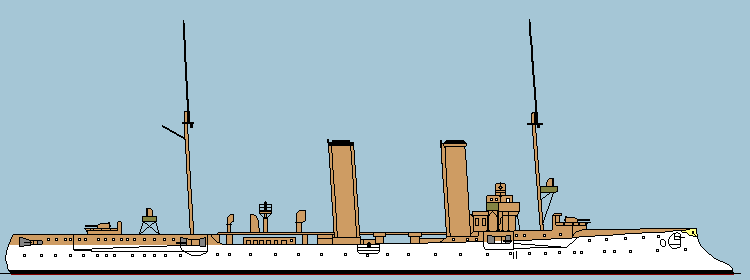
The Gazelle class comprised the first modern small cruisers built for the Imperial German Navy. The design began a line of development that culminated in Emden, the first German cruiser completed after World War I. With ten ships, the Gazelles were also the largest class of German small cruisers. Because construction extended from 1897 to 1904, individual ships differed in dimensions and appearance as the design evolved.
The Gazelle class introduced the 10.5 cm gun as the standard weapon for German small cruisers. This caliber remained in service even as British cruisers adopted heavier main batteries.
Already obsolete by 1914, the ships served primarily in coastal defense during World War I. Several were lost, while the survivors performed various duties after the war. None was interned at Scapa Flow. Two survivors were later converted into floating antiaircraft batteries during World War II.
In 1916 the Amazone was operation as a U-boat target ship for one year, after that it was used as a floating barrack. Between 1923 and 1930 it served in the Reichsmarine, followed by a long life as a floating barrack until the end of WW2. It was broken down in 1954.
Operational history
Commissioned after three shipyard trial voyages.
Attached to the reconnaissance forces.
Training in the Baltic Sea, followed by a voyage around the British Islands.
Rammed by the Linienschiff Kaiser Wilhelm II, damaging the ships hull.
Repairs in Kiel.
Autumn maneuvers in the North Sea.
Winter voyage to Norway.
Spring voyage to Spain.
Being dispatched to Brest to deliver mail from the training squadron, Amazone runs aground but is not damaged.
Training in the North Sea.
Participation in the autumn maneuvers.
Winter voyage together with the battle fleet.
As part of the reconnaissance forces, Amazone sails to England and the Netherlands. Returning to Kiel, the cruiser rams the Russian sailing ship Anna.
Participation in the autumn maneuvers.
After another year of normal training operation, Amazone is decommissioned and put into reserve status.
Recommissioned at the outbreak of World War I, used as for coastal defence in the Baltic Sea.
Together with other small cruisers, Amazone operates off the Russian coast. During this operation, the Airship M IV lands at the stern of the cruiser.
Rescue operation for the beached cruiser Magdeburg, several wounded crew members could be rescued.
Several reconnaissance operations in the Baltic Sea, including to the Aaland Islands.
Used as a target ship for the U-Boat school.
Decommissioned.
Recommissioned as a training ship.
Decommissioned.
Scrapped in Hamburg.
At a glance
Dimensions, armament, protection and performance.
Construction record