Greater size and endurance
A larger hull and improved machinery made the seven Bremen-class ships useful both with the fleet and on distant foreign stations.
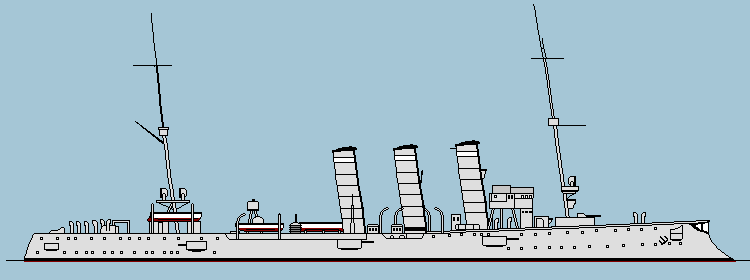
The full story
With the small cruisers of the Bremen class, the German navy started a tradition that would be typical for all following small cruisers and light cruisers of World War II: They were named after German towns. The class consisted of seven ships that did not differ very much from their predecessors, the Gazelle class. One of the ships - the Lübeck - was different in one important detail, for the first time, a turbine engine was installed on a small cruiser instead of the triple expansion engine that was typical for most ships of this time. While being very maneuverable ships, they took over quite a lot of water and started to roll heavily in stormy sears.
Despite not being modern ships at the outbreak of World War I, those ships were used intensively, several were lost and some of them even survived World War II - but not as combat ships anymore.
The Berlin survived the war and was used as a training ship by the Reichsmarine until 1935. After that, the ship was used as a barrack hulk in Kiel and was sunk with gas ammunition on board in 1947.
Operational history
Berlin is commissioned
Test and trials.
Used as an escort vessel to the imperial yacht Hohenzollern, including a visit to Norway. Both, the Swedish king and the Russian Czar visit the small cruiser in this time.
Attached to the fleet.
Fleet maneuvers in the Baltic and North Sea.
Normal fleet operations including spring and autumns maneuvers and the usual summer voyage to Norway.
Normal fleet operations including spring and autumns maneuvers, summer voyage is leading into the Atlantic with visits to Spain.
Normal fleet operations including spring and autumns maneuvers and the usual summer voyage to Norway.
Fully armed and equipped, the Berlin is sent to Agadair to replace the gunboat Panther ("Panthersprung")
Arrived at Agadair.
Sent back to Germany.
After sailing through a heavy storm in the Biscay, Berlin arrives in Kiel.
Attached to the reconnaissance forces of the Hochseeflotte.
Decommissioned and put into naval reserve.
After the outbreak of World War I, the Berlin is recommissioned and used for coastal defenses.
Coast defence operations in the German Beight.
Attached to the cost defence squadron in the Baltic Sea.
Coast defence operations in the German Beight.
Decommissioned in Danzig.
Recommissioned as a stoker training ship.
Reconstruction in Wilhelmshaven. The ram bow is replaced with a modern cruiser bow. The Berlin is put into service as a training ship again.
Voyages to Scandinavia and Holland.
Voyages to Norway, Iceland and the Faroers Islands.
Voyage to Spain.
Training voyage to the Caribbean Sea.
Training voyage to the South America.
Attached to the fleet, training operations in the North Atlantic.
Last training voyage, sent to South-East Asia for over one year.
Decommissioned.
Used as a floating barrack.
Scuttled at Jutland.
At a glance
Dimensions, armament, protection and performance.
The archive
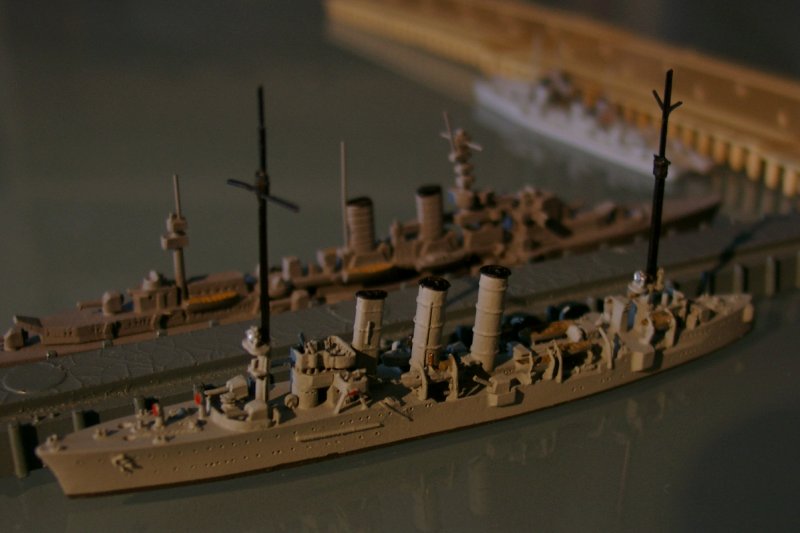
Ship models in 1/1250 scale.
Construction record