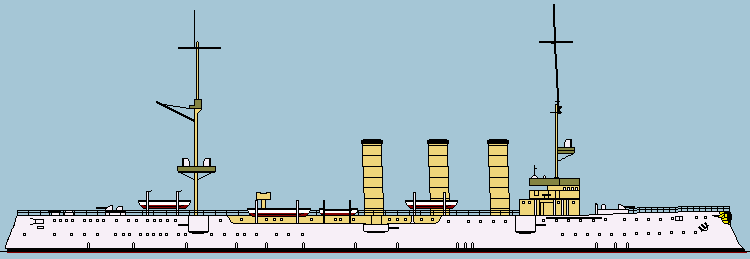
Profile drawing of Königsberg
3814 tMaximum displacement
115,3 mOverall length
24,1 knMaximum speed
322Complement

A cruiser trapped in an African river

Königsberg turned the Stettin-class design into a distinct career shaped by the Imperial Navy's changing peacetime and wartime demands.

01

The turbine transition begins

Four related cruisers introduced evolving machinery arrangements while retaining the established 10.5 cm battery and worldwide utility.
02

Blockaded in the Rufiji Delta

Trapped in the Rufiji Delta after commerce-raiding operations, she resisted British attacks until her crew destroyed the ship.

03

The last chapter in 1915

Königsberg: blown up in the Rufudji-River in East Africa on 11.07.1915.

The full story

History of Königsberg

The small cruisers of the Stettin class were very similar to their predecessors, the Bremen class. There was only a slight increase in size and engine performance, but this did not lead to a higher top speed. The obvious difference to the older ships was a increased space between the second and third funnel. This ships show a different philosophy than its British counterparts - while German small cruiser had a large number of relatively small guns (10 - and later ship classes had even more), the British favored lesser, but bigger guns (15,2 cm instead of 10,5 cm ones).

At a glance

Technical profile

Dimensions, armament, protection and performance.

Dimensions

Size (Max)
3814 t
Length (Total)
115,3 m
Length (Waterline)
114,8 m
Beam
13,2 m
Draft
5,29 m
Crew
322

Armament

10,5 cm
10
5,2 cm
10
45 cm Torpedo tubes
2

Armor

Deck
50 mm (max)

Machinery

Shafts
2
Engines
2
Type
3 cyl triple expansion

Performance

Total Performance
13918 shp
Speed
24,1 kn
Range
5270 miles as 12 kn

The archive

Photographs

Königsberg
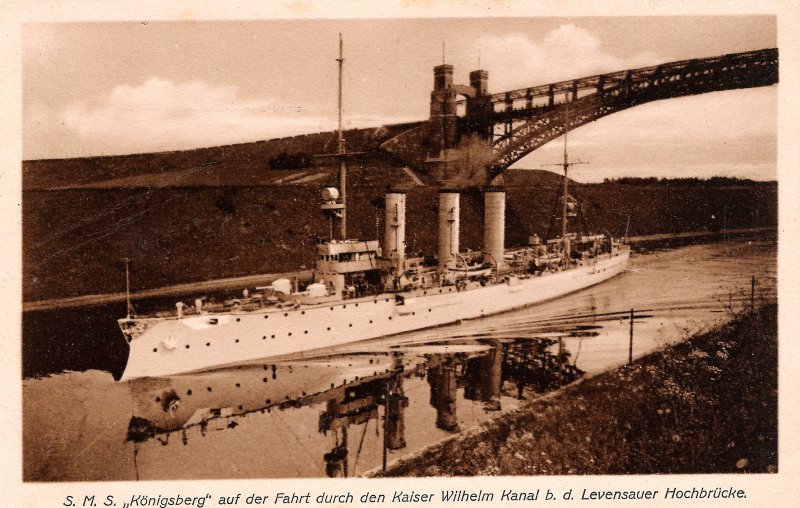
Königsberg (Postcard by C. Speck, sent 03.07.1909)

The archive

Models

Ship models in 1/1250 scale.

Königsberg (I)
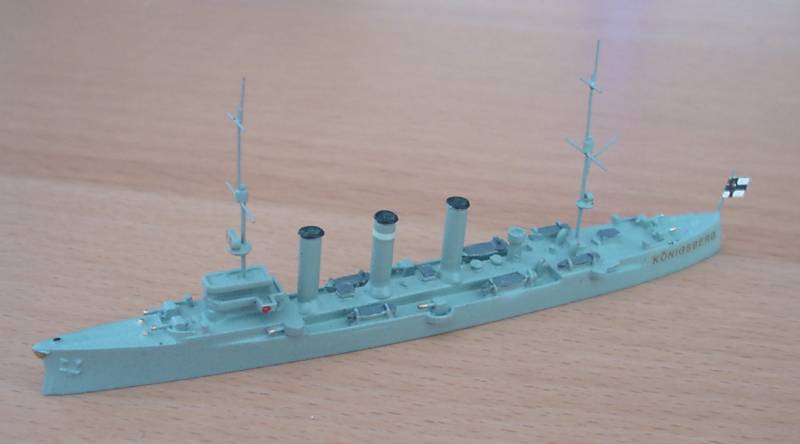
Navis 54 Königsberg

Construction record

Königsberg

Laid down
Kaiserliche Werft Kiel, 1905
Launched
12.12.1905
Commissioned
06.04.1907
Fate
blown up in the Rufudji-River in East Africa on 11.07.1915