More speed and a heavier broadside
Four larger turbine cruisers strengthened the scouting force and entered war as active units in the North Sea and Baltic.
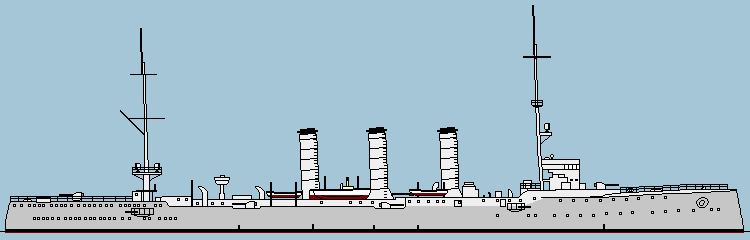
The full story
The small cruisers of the Kolberg class were significant bigger than their predecessor, enabling to add two additional 10,5 cm guns to the ships. All four ships had different kind of turbines to find the best of them for later cruiser designs: Melms & Pfenninger (Kolberg), Parsons (Augsburg), Schneider-Zoelly (Cöln) and AEG-Curtis (Mainz). Those installed in the Cöln proofed to be very unreliable therefore they were exchanged with Germania-turbines after trials.
Like many other small cruisers, their main armament was replaced during the war, the twelve 10,5 cm guns were replaced with six 15 cm guns. They were good seagoing ships, but had a bad maneuverability.
The Augsburg had a very uneventful life in the Imperial Navy. Before the war it was used for torpedo trials and served as an artillery training ship from 1912 on. In the war it was used for fleet operations in the Baltic Sea and took part in the operations at the Baltic Island. In September 1920 it was delivered to Japan but as Japan had no use for the ship, it was scrapped in the Netherlands in 1922.
Operational history
Commissioned.
During trials, the Augsburg supports rescue operations for the sunken U-boat U3.
Attached to the torpedo experimental department as torpedo training and experimental ship.
Training and maneuvers in the Baltic Sea.
Torpedo exercises in Norwegian waters.
Repairs and refits.
Operating in the squadron of training and experimental ships.
Now used as artillery training ship.
Repairs and refits at the Kaiserliche Werft, Danzig.
Beached after a heavy storm at Sonderborg, the Augsburg got afloat again after some hours.
Support of the salvage operation of the beached Grosser Kreuzer Blücher.
Repairs and refits.
Attached to the Coastal Defence forces.
Together with the small cruiser Magdeburg, the Augsburg laid a mine filed off the port of Libau and bombarded the harbor defenses.
Operation in the eastern Baltic Sea.
Operation in the eastern Baltic Sea.
Operation in the eastern Baltic Sea together with the small cruiser Magdeburg, which were lost in this operation.
The cruisers is unsuccessfully attacked by the Russian destroyer Novik.
Short engagement with the Russian cruisers Oleg and Bogotyr.
Another engagement with Russian warships, the armored cruisers Bajan and Pallada. The Augsburg escaped undamaged.
Destruction of the Russian steamer Uleaborg.
During another operation in the Baltic Sea, the cruiser is hit by a mine, but could sail to Stettin with its own power.
Repairs at Blohm & Voss in Hamburg.
Bombardment of Libau.
Several mine operations off the Russian Coast.
Bombardment of Windau.
Engagement with Russian cruiser forces.
The Augsburg is lightly damaged by artillery fire during an operation near Riga.
In six mine operation, the Augsburg and other ships laid 3485 mines in the Baltic Sea.
Seaplanes, launched by the Augsburg and other ships attacked Reval.
Damages to the cruiser's hull during another operation off Riga.
Repairs at the Kaiserliche Weft, Kiel. The 10,5 cm guns are replaced with six 15 cm guns.
Operation at the Baltic Islands.
Augsburg is attached to the U-Boat school.
Assigned as Flagship to the mine hunters flotillas of the Hochseeflotte.
Decommissioned.
Delivered to Japan as "Y " and scrapped in Dordrecht, Netherlands.
At a glance
Dimensions, armament, protection and performance.
The archive
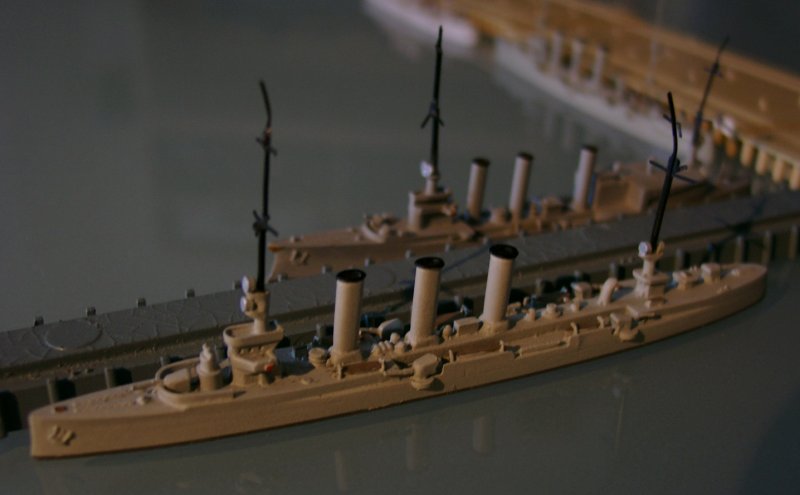
Ship models in 1/1250 scale.
Construction record