Greater size and endurance
A larger hull and improved machinery made the seven Bremen-class ships useful both with the fleet and on distant foreign stations.
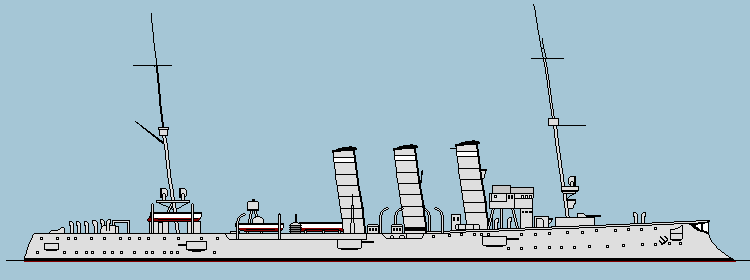
The full story
With the small cruisers of the Bremen class, the German navy started a tradition that would be typical for all following small cruisers and light cruisers of World War II: They were named after German towns. The class consisted of seven ships that did not differ very much from their predecessors, the Gazelle class. One of the ships - the Lübeck - was different in one important detail, for the first time, a turbine engine was installed on a small cruiser instead of the triple expansion engine that was typical for most ships of this time. While being very maneuverable ships, they took over quite a lot of water and started to roll heavily in stormy sears.
Despite not being modern ships at the outbreak of World War I, those ships were used intensively, several were lost and some of them even survived World War II - but not as combat ships anymore.
The Bremen was used in overseas services between 1904 and 1914. Used for fleet operations in the Baltic Sea after that, the ship was lost when hit by a mine near Windau on 17.12.1915 while trying to help the torpedo boat V191 which was damaged by a mine hit, too.
Operational history
Bremen is commissioned.
Test and trials.
Sent to South America.
Arrived at Rio de Janeiro.
Repairs in Newport News, USA.
Bremen operates off the South American coast and the Caribbean Sea.
Repairs in Newport News, USA.
Rescue operation for the beached passenger ship Prinzessin Victoria Loise, Bremen takes over passengers and unsuccessfully tries to rescue the ship.
Bremen operates off the South American coast.
Repairs in Newport News, USA.
Visits to several ports in the USA.
Sent to Haiti to assist european citizens in the revolutions on Haiti.
Visits to Philadelphia and New York.
Repairs in Newport News, USA, followed by visits to several ports in the USA.
Arrived at Buenos Aires.
Visits to several ports in South America.
Sent to Honduras to assist european citizens in the revolutions in Honduras.
Visit to Costa Rica.
Bremen meets the battlecruiser Von der Tann at Rio de Janeiro.
Repairs in Newport News, USA.
Sent to Haiti to assist european citizens in the revolutions on Haiti.
Repairs in Newport News, USA.
Together with the battlecruiser Moltke and the small cruiser Stettin, the Bremen visits the USA.
Ordered to West Africa to assist German gunboats there.
Arrived at Monrovia.
Bremen returns to South America.
Ordered back to Germany.
Return order to Germany canceled, because the replacement cruiser was not available yet.
Bremen operates off the Mexican coast to protect european citizens.
Ordered back to Germany.
Arrived in Bremen after 9,5 years in overseas service.
Decommissioned in Wilhelmshaven.
Bremen is rebuild, four 10,5 cm guns are replaced with two 15 cm ones. Funnels and masts are modified.
Commissioned, followed by trials in the Baltic Sea.
Attached to the Baltic Sea reconnaissance forces.
Several operations in the Baltic Sea, including coastal bombardments.
While trying to rescue the crew of the Torpedo boat V191 which run on a mine, the Bremen is hit by two mines itself. Sunk in a short time, causing about 300 causalities.
At a glance
Dimensions, armament, protection and performance.
Construction record