Greater size and endurance
A larger hull and improved machinery made the seven Bremen-class ships useful both with the fleet and on distant foreign stations.
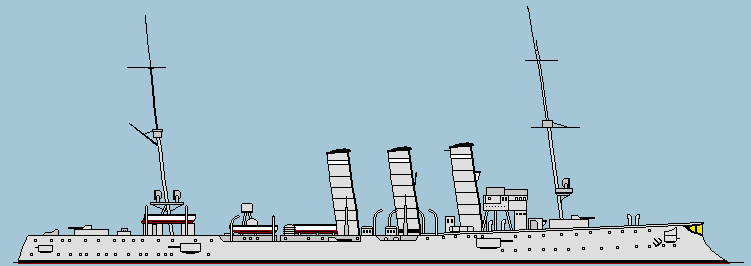
The full story
With the small cruisers of the Bremen class, the German navy started a tradition that would be typical for all following small cruisers and light cruisers of World War II: They were named after German towns. The class consisted of seven ships that did not differ very much from their predecessors, the Gazelle class. One of the ships - the Lübeck - was different in one important detail, for the first time, a turbine engine was installed on a small cruiser instead of the triple expansion engine that was typical for most ships of this time. While being very maneuverable ships, they took over quite a lot of water and started to roll heavily in stormy sears.
Despite not being modern ships at the outbreak of World War I, those ships were used intensively, several were lost and some of them even survived World War II - but not as combat ships anymore.
Before the war, the small cruiser Danzig was used for fleet operations and as a artillery training ship. In 1914 she was again used for fleet operations and took part in the battle of Helgoland and the operations at the Baltic Islands. In 1919, the ship was delivered to England and scrapped there.
Operational history
Danzig is commissioned.
Test and trials.
Fleet service as part of the reconnaissance forces.
Fleet maneuvers in the North Atlantic.
Visit to Spain.
Assigned as artillery training ship.
Together with the Prinz Adalbert, the Danzig executes artillery training near the Faroers Islands.
Attached to the training ship squadron.
Repairs and refits.
Several training voyages as part of the training ship squadron.
Used for defenses of the Kiel Beight.
Assigned to the III Reconnaissance group in the North Sea.
After the battle at Helgoland, Danzig is sent to rescue any survivors of the sunken German ships. 170 crew members of the small cruiser Ariadne could be rescued.
Operation off the Finnish coast.
The cruiser covers a mine operation at the Doggerbank. On its way back to Germany, the Danzig is hit by a British mine, disabling all engines and has to be town by the small cruiser Berlin.
Repairs in Bremen.
Sent do Libau for another mine operation.
Hit by a mine again, the rudder is lost and all stern sections are flooded.
Repairs in Bremen.
Coast defence in the German Beight.
The cruiser covers several mine operations.
Attached to he 2nd Reconnaissance Group of the Hochseeflotte.
Mine operations between Norderney and Helgoland.
Used as a target ship for the U-Boat training school.
Decommissioned.
Stricken from fleet list.
Taken over by Britain.
Scrapped.
At a glance
Dimensions, armament, protection and performance.
Construction record