Greater size and endurance
A larger hull and improved machinery made the seven Bremen-class ships useful both with the fleet and on distant foreign stations.
The full story
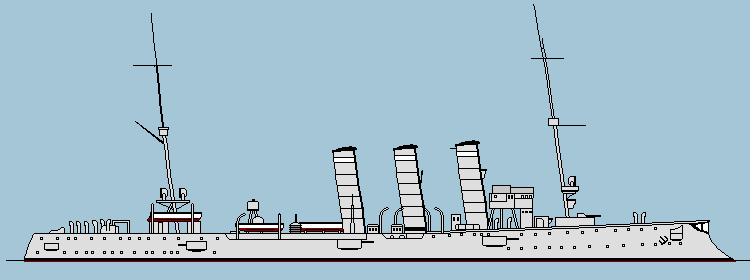
With the small cruisers of the Bremen class, the German navy started a tradition that would be typical for all following small cruisers and light cruisers of World War II: They were named after German towns. The class consisted of seven ships that did not differ very much from their predecessors, the Gazelle class. One of the ships - the Lübeck - was different in one important detail, for the first time, a turbine engine was installed on a small cruiser instead of the triple expansion engine that was typical for most ships of this time. While being very maneuverable ships, they took over quite a lot of water and started to roll heavily in stormy sears.
Despite not being modern ships at the outbreak of World War I, those ships were used intensively, several were lost and some of them even survived World War II - but not as combat ships anymore.
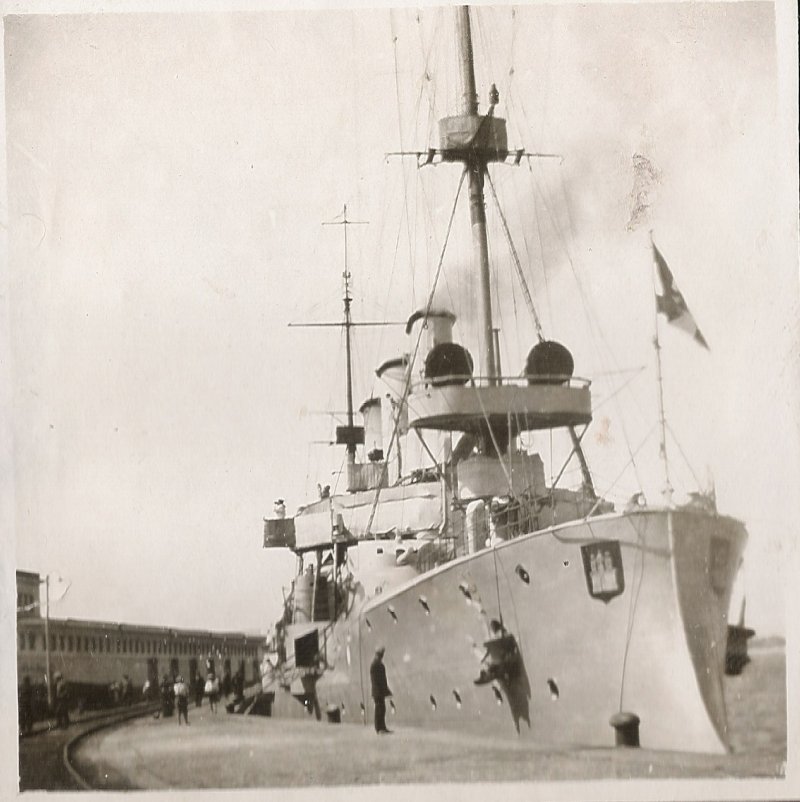
Hamburg was the flagship of the "Commanders of the U-boats" and took part in the Battle of Jutland. It too was taken over by the Reichsmarine and used as a training ship until 1931. From 1936 on, it served as a floating barrack for U-boat crews and was sunk during an air raid on Hamburg in 1944.
Operational history
Hamburg is commissioned.
Used as an escort vessel to the imperial yacht Hohenzollern.
Fleet service as part of the reconnaissance forces.
Participation in the fleet winter exercises in the Baltic Sea.
Used as an escort vessel to the imperial yacht Hohenzollern to Helgoland.
Speed comparisons between the Hamburg and its turbine powered sister ship Lübeck.
Used as an escort vessel to the imperial yacht Hohenzollern to Pillau and Glücksburg.
The cruiser takes part in the Atlantic voyage of the reconnaissance forces.
Used as an escort vessel to the imperial yacht Hohenzollern to the Mediterranean.
The cruiser takes part in the Atlantic voyage of the reconnaissance forces.
Used as an escort vessel to the imperial yacht Hohenzollern to the Mediterranean.
Because of riots in Turkey, the Hamburg is sent to Mersina.
The cruiser returns to Kiel.
Together with the Armored Cruiser Gneisenau, the Hamburg escorts the imperial yacht Hohenzollern to Finland.
Used as an escort vessel to the imperial yacht Hohenzollern to the Scandinavia.
Decommissioned and put into the fleet reserve.
Commissioned and used as command ship of the U-Boat fleet.
Together with the small cruiser Stettin and 10 U-Boats, the Hamburg operates NW of Helgoland.
Another operation together with several U-Boats.
As part of the reconnaissance and U-Boat group, the Hamburg takes part in the raid to shell Hartlepool. The cruiser engaged several British destroyers while assisting own torpedo boats.
The cruiser rams and sinks the torpedo boat S21, causing some damage to the cruiser as well.
Participation in fleet operations.
Participation in fleet operations.
Participation in fleet operations.
Participation in fleet operations.
Participation in fleet operations.
Participation in fleet operations.
Participation in fleet operations.
Participation in fleet operations.
Battle of Jutland: During the night battles, the cruiser defended several attack by British destroyers and cruisers, the ship is hit several times, causing several casualties.
Repairs.
Participation in fleet operations.
Because of its age and limited operational use, the ships crew is reduced and used as stationary staff command ship in Wilhelmshaven.
Decommissioned.
Recommissioned as flagship of the North Sea flotilla.
Visit to the Shetland Islands.
Together with two mine hunter flotillas, the cruiser is sent to the Baltic Sea and Arctic Sea to remove mines laid during WW1. While operating in the Cola Beight, the ships are shelled by Russian coastal artillery.
Ice emergency operations in the Baltic Sea, the cruiser is damaged during this operations.
Participation in fleet exercises.
Visit to Riga.
As its last voyage, the Hamburg makes a training voyage around the world: England, Spain, West Indies, Panama Channel, Middle- and North America, Hawaii, Japan, the Philippines, Indonesia, Suez Channel, Mediterranean.
Decommissioned and put into fleet reserve.
Used as floating barrack in Kiel and Hamburg.
Sunk during British air attack on Hamburg.
Wreck raised.
Wreck scrapped.
At a glance
Dimensions, armament, protection and performance.
The archive
Construction record