More speed and a heavier broadside
Four larger turbine cruisers strengthened the scouting force and entered war as active units in the North Sea and Baltic.
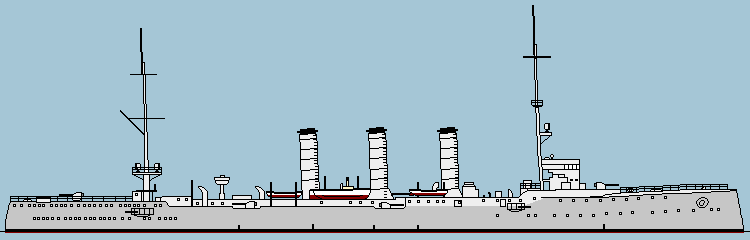
The full story
The small cruisers of the Kolberg class were significant bigger than their predecessor, enabling to add two additional 10,5 cm guns to the ships. All four ships had different kind of turbines to find the best of them for later cruiser designs: Melms & Pfenninger (Kolberg), Parsons (Augsburg), Schneider-Zoelly (Cöln) and AEG-Curtis (Mainz). Those installed in the Cöln proofed to be very unreliable therefore they were exchanged with Germania-turbines after trials.
Like many other small cruisers, their main armament was replaced during the war, the twelve 10,5 cm guns were replaced with six 15 cm guns. They were good seagoing ships, but had a bad maneuverability.
Kolberg took part in the Battle of Helgoland, the Battle of the Doggerbank and the operations at the Baltic Islands. In 1920 it was delivered to France where it was renamed to Colmar and served until 21.07.1927. It was scrapped in 1929.
At a glance
Dimensions, armament, protection and performance.
Construction record