The foundation of the small-cruiser line
Ten compact cruisers established the combination of overseas range, fleet scouting ability and quick-firing guns developed by every following class.
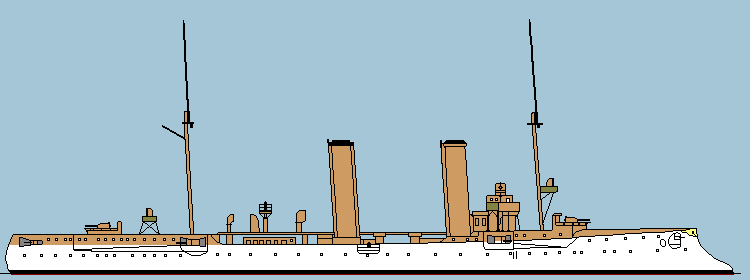
The full story
The Gazelle class comprised the first modern small cruisers built for the Imperial German Navy. The design began a line of development that culminated in Emden, the first German cruiser completed after World War I. With ten ships, the Gazelles were also the largest class of German small cruisers. Because construction extended from 1897 to 1904, individual ships differed in dimensions and appearance as the design evolved.
The Gazelle class introduced the 10.5 cm gun as the standard weapon for German small cruisers. This caliber remained in service even as British cruisers adopted heavier main batteries.
Already obsolete by 1914, the ships served primarily in coastal defense during World War I. Several were lost, while the survivors performed various duties after the war. None was interned at Scapa Flow. Two survivors were later converted into floating antiaircraft batteries during World War II.
All ships were used for fleet service until the outbreak of World War I. Medusa first served as a coastal defense ship until it was used as a tender. After four year of service for the reichsmarine from 1920 on, it was used as a floating barrack until 1940. It then was converted in to a Floating AA Battery and sunk on 03.05.1945.
At a glance
Dimensions, armament, protection and performance.
Construction record