Russian orders completed for Germany
Two cruisers begun for Russia were adapted to German weapons and service, then fought with the Imperial Navy in the North Sea.
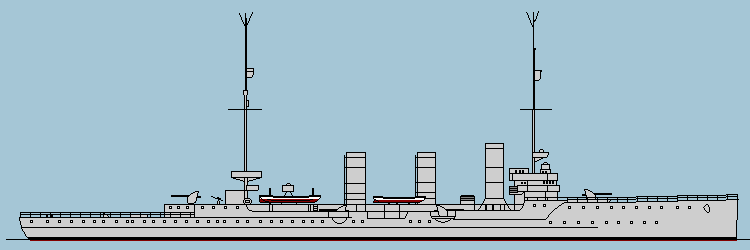
The full story
The small cruiser Pillau and its sister ship Elbing were quite unique in the German Imperial Navy. Although being very similar to the ships of the Königsberg II class these cruisers were different - they were originally ordered by Russia as Muavjev Amurskij and Admiral Nevelovsk in 1913. At the outbreak of the war, both ships were almost completed and taken over by the German Navy.
Both ships took part in the battle of Jutland as part of the II Reconnaissance Group. They engaged British cruisers and during the battle, the Pillau was hit by a British 30,5 cm shell disabling four boilers, but the ship could escape. Elbing was not damaged this way, but it was rammed by the old German battleship Posen while evading British destroyers and sunk after that. After the war, Pillau was delivered to Italy in 1920 and was renamed Bari. Between 1934 and 1935 it was modernized, reducing its funnels to two. The ship was still in active service in the Italian Fleet during World War II when Italy surrendered in September 1943 and it was sunk in Livorno after American bombing attacks and scuttling by its crew on.09.09.1943. The wreck was broken down in 1944.
Operational history
Training and trials.
Attached to the 2nd Reconnaissance group.
Mine laying operations.
Operations in the Baltic Sea.
Together with the cruiser Augsburg, and the torpedo boats V99 and V100, the Pillau is sent for a reconnaissance operation near Irben Strait.
Bombardment of Zerel (Swalferort).
Attacked by Russian submarine Drakon, no damage on the cruiser.
Pillau, Bremen and several torpedo boats are used for a cover operation of minesweepers in the Irben Strait.
Bombardment of Arensburg.
Bombardment of Dagerort.
The cruiser is sent back to the North Sea.
Operations with the Hochseeflotte.
Battle of Jutland: Together with other ships of the 2nd Reconnaissance Group, the Pillau fights against the CL Chester and later against the BC Invincible. Pillau is hit, disabling the oil-fired boilers.
Escorts the damaged battlecruiser Seydlitz back to Germany.
Pillau covers the rescue operations of the U-boat U20 near the Danish coast.
Patrol duties and escorting of U-boats.
Operation in the Baltic Sea.
Battle with light British forces near Helgoland. Pillau scores some hits on British destroyers and is hit by one shell itself.
Repairs in Wilhelmshaven.
Put into reserve.
Taken over by Italy as reparation ship "U ", renamed Bari. Equipped with additional 76 mm guns (3x)
Refitted as "colonial cruiser".
Operations near Corfu.
Convoy duty in the Adriatic, shore bombardments of the Montenegro coastline.
Modernization as anti-aircraft cruiser started at Livorno.
Sunk in Livorno.
Hull exploded by Italian forces to prevent capture by German troops.
Wreck scrapped.
At a glance
Dimensions, armament, protection and performance.
The archive
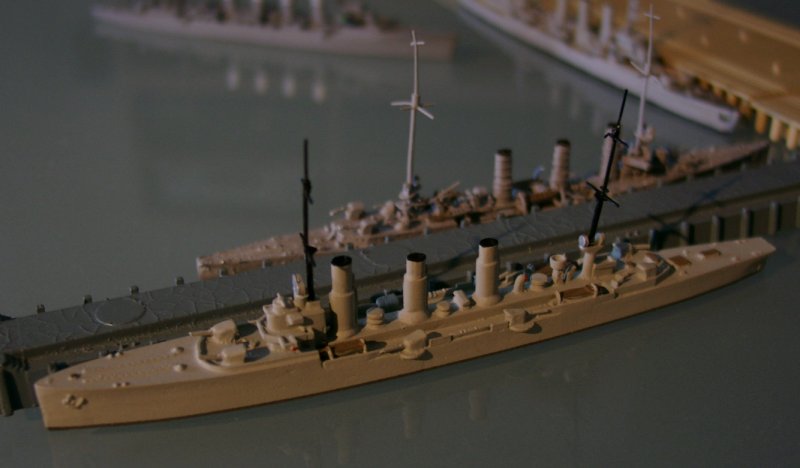
Ship models in 1/1250 scale.
Construction record