The turbine transition begins
Four related cruisers introduced evolving machinery arrangements while retaining the established 10.5 cm battery and worldwide utility.
The full story
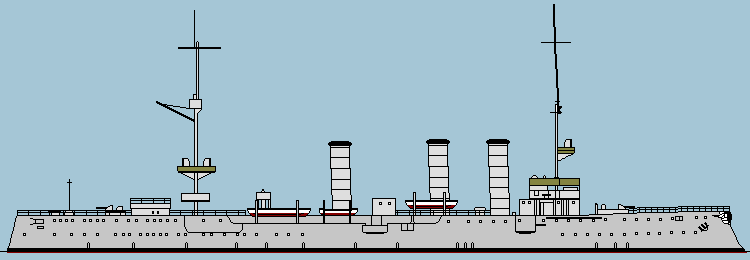
The small cruisers of the Stettin class were very similar to their predecessors, the Bremen class. There was only a slight increase in size and engine performance, but this did not lead to a higher top speed. The obvious difference to the older ships was a increased space between the second and third funnel. This ships show a different philosophy than its British counterparts - while German small cruiser had a large number of relatively small guns (10 - and later ship classes had even more), the British favored lesser, but bigger guns (15,2 cm instead of 10,5 cm ones).
The Stuttgart was first used as an artillery training ship and participated in several fleet actions after the outbreak of the war, including the Battle of Jutland as part of the 4th reconnaissance group. In Spring of 1918, the ship was converted into a seaplane carrier, adding a hangar for three aircraft, but removing six of the 10,5 cm guns. Although it entered service again in May 1918, it did not see much action anymore. In July 1920 it was delivered to England and broken down soon after that.
At a glance
Dimensions, armament, protection and performance.
The archive
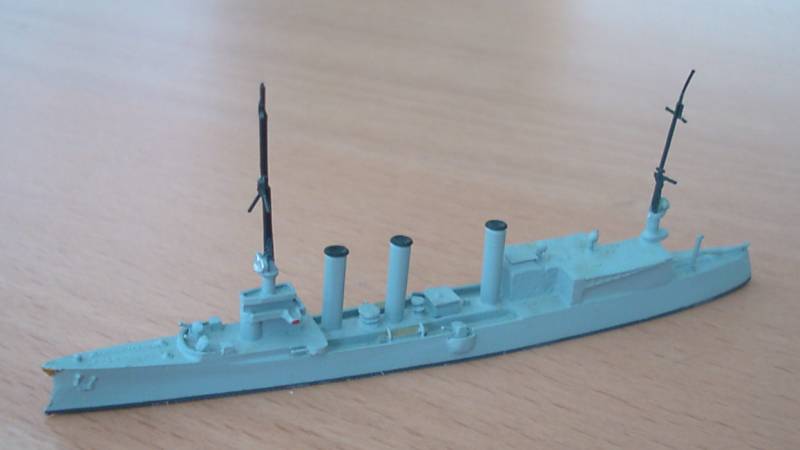
Ship models in 1/1250 scale.
Construction record