The 15 cm battery becomes standard
Eight heavier guns gave the class stronger striking power at the price of remaining vulnerable in close fleet action.
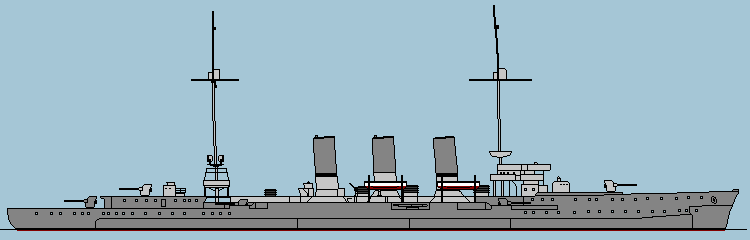
The full story
The two small cruisers Wiesbaden and Frankfurt were built under the 1912 naval construction program. They were the first German small cruisers equipped with 15 cm guns, a step to close the gap with the heavier armed British cruisers. In all other respects they were only slightly improved to their predecessors.
Wiesbaden entered fleet service in the reconnaissance forces of the Imperial Navy and took part in the Battle of Jutland. There the ship was heavily shelled by British battlecruisers disabling the engines of the ship. Although hit by intensive fire of the 3rd Light Cruiser Squadron, the destroyer Onlsow, the armored cruisers Defence and Warrior, the Wiesbaden was still able to torpedo the British battleship Marlborough. The Wiesbaden was sunk shortly after that, with the German poet Gorch Fock on board.
Operational history
Wiesbaden is commissioned.
With other ships of the 2nd Reconnaissance Group, the Wiesbaden covers the operation of three torpedo boat flotillas.
Operations in the North Sea.
Operations in the North Sea.
Wiesbaden is sent into the North Sea to assist the airship L13 which had sent off emergency calls. The airship was able to reach Germany with its own power.
Operations in the North Sea near Hornsriff.
Operations in the North Sea near Lowestoft.
Unsuccessful attempt to rescue the airship L20.
Battle of Jutland: After heavy artillery hits, the cruiser was dead in water at about 17:48. Several hours later, the cruiser sank the next day at 2:45, only one crew member survived.
At a glance
Dimensions, armament, protection and performance.
The archive
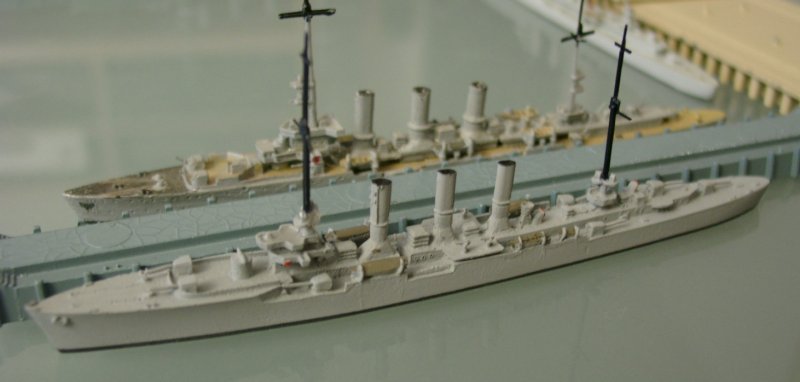
Ship models in 1/1250 scale.
Construction record