Dimensions
- Size (Max)
- 18160 t
- Length (Total)
- 203,0 m
- Beam
- 27,0 m
- Draft
- 8,85 m
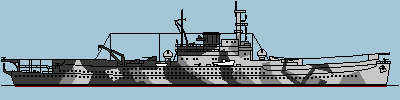
Design and conversion
The passenger ship Gneisenau (not to be mismatched with the battlecruiser Gneisenau) of the North German Lloyd line was one of the three passenger ships which should be converted to auxiliary carriers in 1942 (Project Jade). It was originally used for passenger cruises to the far east, after the start of World War II it was used as a troop transport. Detailed studies started initially after the conversion was decided on 13.05.1942, it was planned to use the Kriegsmarine Shipyard in Wilhelmshaven for later that year. Because of the lack of stability and the high fuel consumption, the project was stopped on 25.11.1942 without any modification done. It was planned to modify the ship to a troop transport able to carry and unload 80t tanks, but this project was also stopped. On 02.05.1943, the Gneisenau capsized after hitting a mine in the Baltic Sea, the wreck was broken down in 1950.
The sister ship of the Gneisenau, the passenger ship Scharnhorst was converted into a aircraft carrier - by the Japanese. At the outbreak of the war, the Scharnhorst was in Japan. In July 1942, the ship was sold to Japan and modified into an aircraft carrier. Now named Jinyo, the ship entered service in December 1943 and sunk by the US submarine Spadefish northeast of Shanghai on 17.11.1944.
Projected data
Dimensions, air group, armament and performance.